

What It’s Like to Date Men During the Manosphere Era
One UNASB-er’s experience dating against a backdrop of disconnect.

UNASB studies right-wing messaging and how real world conditions help right-wing commentators grow their audiences. Some of those conditions have been major dynamics in my own life: rising loneliness, increasing gender polarization, and what’s been called a romantic recession. They’ve been most salient in one domain in particular: dating.
In dating, the opportunity for connection is immense. Connection, after all, is the whole point.
This might sound like a simple, obvious fact. But you wouldn’t know it from the discourse: Engage with dating content and punditry today and you’ll find it focuses mostly on self-protection, usually at the expense of connection. Dating is treated as a game to win, and daters as assets with value to be assessed, increased, and traded. These messages capitalize on partial truths (a tactic we’ve been tracking since the earliest days of UNASB). Dating carries real risk, across many dimensions; early dating can feel like a game, a frequent complaint among daters; and sometimes it functions like a market, especially on dating apps which, for better and worse, are the highest yield pool in the space.
This discourse fails to capture the intangibles, like falling in love, and the infinite river of human connection along the way. And isn’t that what we’re really looking for? We want to matter, and we don’t want to be alone. On the flip side, we fear isolation and irrelevance. And when that core fear is activated, we become easy to exploit.
Enter: the right-wing media ecosystem—and the bad actors within it, peddling red pill ideology and the like. How do we counteract their messaging?
We don’t, not exactly. The ones who are fully red-pilled are straight-up dangerous to women and not for dating, obviously. They might be beyond our reach entirely. But there’s a huge distance between your average Rogan listener vs. the virulent misogyny of an Andrew Tate devotee. And when it comes to those in the former camp, who are still reachable, we can learn to better connect with them if only we are willing to try.
The Manosphere & the Understory
Two-thirds of young men regularly engage with masculinity influencers—a massive network of voices ranging across many different, but often intersecting, genres and messaging themes. This is “The Manosphere”, a catch-all term that, while useful as shorthand, fails to capture the range of the ecosystem. So let’s dig in...
Seeking Belonging
The loneliness epidemic has not been limited to men, but there is real value in examining the particular ways it has impacted them. And as a (female) victim of the loneliness epidemic myself, I think that examination ought to start with empathy.
Loneliness distorts how we see each other, ourselves, and the world. Its effects are destructive and self-reinforcing: People who feel unseen withdraw socially, and over time, many harden into their solitude, avoiding the thing they need most: intimate contact with others (We’re Living Through the Great Detachment). When I experienced chronic loneliness, I was relatively well-equipped to claw my way out. My gender was one advantage that enabled me to be vulnerable in reaching out for support, and likely contributed to the sympathetic response when I did. Male socialization and gender norms—the ways in which we train boys out of displaying anything resembling “weakness”—would’ve made that much more difficult.
Throughout our UNASB journey, we’ve found that many of the most influential podcasts thrive on an aspirational connection between hosts and listeners. You can imagine how a lonely guy might be especially primed for this—especially when it offers something his real life doesn’t, like a sense of being part of the cool kids’ table. The Flagrant podcast, hosted by a group of funny, charismatic guys casually hanging out and serving up hot takes, is a good example of this, as UNASBers have noted.
In practice: Use humor and humility to create space for vulnerability. The Joe Rogan recipe. Rogan often calls himself a moron, which reinforces his persona as the Everyman, not an expert just a comedian having casual conversations. In a JRE interview with Theo Von, we saw how his characteristic style creates space for his guest to be vulnerable, as Von says how scared he’s been, describes feeling heartbroken over the state of the world, and talks about wanting to get off antidepressants and take his “power back”. On his own podcast, Von often uses self-deprecating jokes—hitting on both humor and humility—to similar effect. This works because it’s disarming, a way of dropping pretenses and inviting your conversation partner to do the same.
Dating tip: To show humility, keep this phrase in your back pocket (borrowed from Mónica Guzmán): “I never thought of it that way.”
Seeking Agency
Rising wealth concentration and corporate consolidation, declining affordability and class mobility, uncertainty and economic destabilization amidst the rise of generative AI… These forces are reshaping American life. It’s no wonder so many are feeling as though their paths to self-determination have all but vanished.
For single men, add to that a relative decline in earning power and educational attainment compared to the women they are courting, to whom they are paradoxically still expected to demonstrate value as a provider. For some there is also a sense of being socially diminished, which seems to be mostly experienced on a vibes-level, for example as a sense of being censored, silenced, or disempowered in culture. It’s easy to trivialize these feelings, but if there’s one thing we’ve learned in the last decade, it’s that we shouldn’t. They reflect a deeply human need for respect and recognition from others, typically derived from status, wealth, beauty, etc. To be, or feel as though you’ve been, demoted within this social order is not a trivial thing. It’s also a more accessible thing to push against than, say, institutional power structures.
Reckoning with a felt loss of power and standing, one might naturally look for ways to regain a sense of control. The idea of being high agency — that is, believing in and acting upon one’s ability to influence their own life circumstances — is a cornerstone of the mainstream Manosphere. We on the left should learn from them in this regard because, even though it’s been co-opted in some cases by opportunists, the value of agency itself is a good one and an analog for hope.
In practice: Life stories: In a date setting—-or anytime you meet someone new and have the opportunity to get to know them 1-1—-one way you might speak to this need for personal agency is to ask questions designed to elicit their story, as they want it told. The way they tell it will show you a lot, including how they see themselves, which is an insight into how they want to be seen.
Examples of how to do this:
How Questions: How did you come to believe X? (Not: Why do you believe X?).
Characters: Tell me about the person who shaped your values most? (Instead of: Tell me about your values?).
Joe Rogan as a reference: Rogan is skilled at this. Interviewing Palmer Luckey, he creates a container for Luckey to mythologize himself as a plucky and appealing sort of protagonist: A sci-fi loving boy genius, free-thinking innovator, and the “luckiest guy in the world” (pun and personal branding gimmick intended)—someone who forged his own path via, you guessed it, exceptionally high personal agency. Luckey is an example of how a positive value like agency can be appropriated, in this case to whitewash some of the more eyebrow-raising parts of his bio.
Start with “You and I both know…” to set up a frame of respect. When you want to explain something or impart information, start with an offhanded, “As we know, X...” This tactic, which UNASB has seen used by right-wing podcasters from Benny Johnson to the late Charlie Kirk, works as a pre-buffer against the listener feeling condescended to. It’s a light-touch way to establish a premise, something your listener will accept as ‘known’—not something to attach to your point directly.
Exercising Discernment
Early dating can be a balancing act between having a good time and determining compatibility. Having better, more productive conversations serves both goals: 1. Generally leads to dates being more enjoyable than they might’ve been otherwise, and 2. If you have them deftly and early, can help you gauge compatibility and move more swiftly towards the right relationship with the right match.
Who we each choose to love and partner with is deeply personal and highly individualized, so only you can say what the bounds of political and ideological compatibility are for you. Maybe conspiracy theories don’t bother you, but offensive language is a dealbreaker. Or maybe your bar for Elon Musk apologism is on an income-based sliding scale. Whatever your parameters, discernment is key to being a ‘better buyer’.
Try this: Complicate the narrative (Good Conflict). People are complicated; resist the urge to collapse them into simple dichotomies. Remember that there are weekly Flagrant listeners out there who are also devoted students of bell hooks, which doesn’t necessarily make them your love match, but does paint a richer picture of their interiority.
Try adjusting the conversational frame to make space for complexity. Instead of a direct question about favorite podcasts or voting history, you might try something like:
Who are some public figures you follow whose perspectives are in tension with each other? What do they disagree on?
Which voices in your media diet connect with different aspects of your identity and how you see the world?
Look for shared values. In his book The Righteous Mind, Jonathan Haidt identifies six core moral foundations, byproducts of how humans evolved within group systems that promote survival, reproduction, and cooperation. These moral foundations—and the varied ways different people prioritize and apply each of them—underpin most political and ideological positions, and are easily activated by political rhetoric, as UNASBers have observed across content we’ve covered. Moral foundations map closely onto partisanship: Care and fairness are important to most people but weighted more heavily by liberals, whereas loyalty, authority, and sanctity align more with conservative values.
But people don’t sort as cleanly into partisan camps as they used to: Americans increasingly hold mixes of views that do not cohere into a consistent ideology, and more of us than ever before identify as political independents, including a majority of Gen-Z (Gallup). Then there are those who are simply exhausted by politics and choosing to opt out altogether. It’s in these instances that moral foundations can be most helpful in determining values and applying discernment. Here’s how:
Pay attention to how someone justifies a belief, not just what the belief is. Try to ascertain the moral foundation that underlies a position. For example, MAHA-esque distrust of big pharma and food/ag could be rooted in the moral foundation of Care, i.e., protecting people’s bodies from harm. If you can appreciate where it’s coming from, that is at least a starting point from which to have a productive conversation.
Watch for disgust. The stickiest foundation is sanctity, which tends to be revealed in a person by what triggers their disgust. Disgust is visceral, and tough if not impossible to negotiate with. If someone’s disgust reactions clash hard with yours, you might reasonably call it a fundamental incompatibility.
We exist in the context
We meet each other in context, that is, in the current atmosphere of disconnection. It’s a tough landscape for the practice of connection, full of trip wires. None of this has ever been easy, and it’s harder now than it’s ever been. But it will only get better if we make it better.
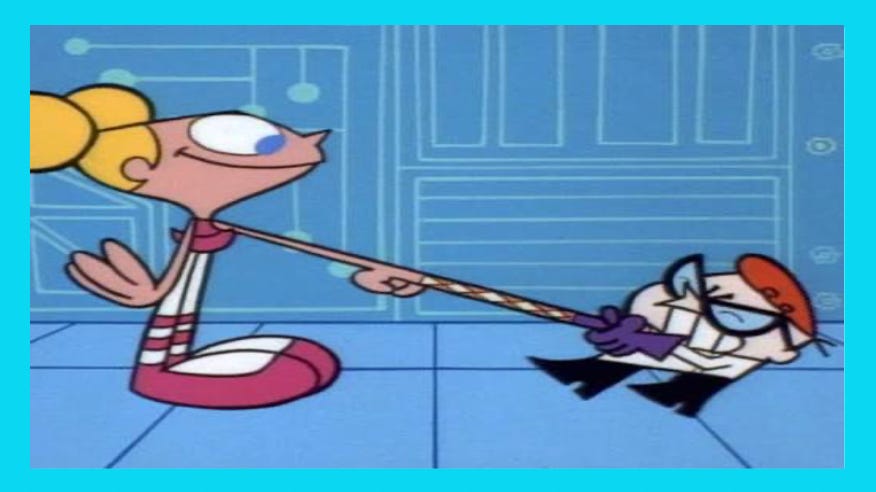
Growing up in the 90s/00s, there was a plot device used in a lot of kids’ shows that I think can be useful here: the finger trap toy. A symbol of the idea that, when you feel the instinct to pull away from someone, you might try going towards instead. And just see where that gets you.
 | A guest post by
|