


Welcome back to UNASB! This newsletter serves as a recap of our last meeting. As a reminder, here at UNASB, we listen to conservative-leaning podcasts, analyze their messaging and themes, and brainstorm actionable ideas for how the Democratic coalition can strengthen its own approach.
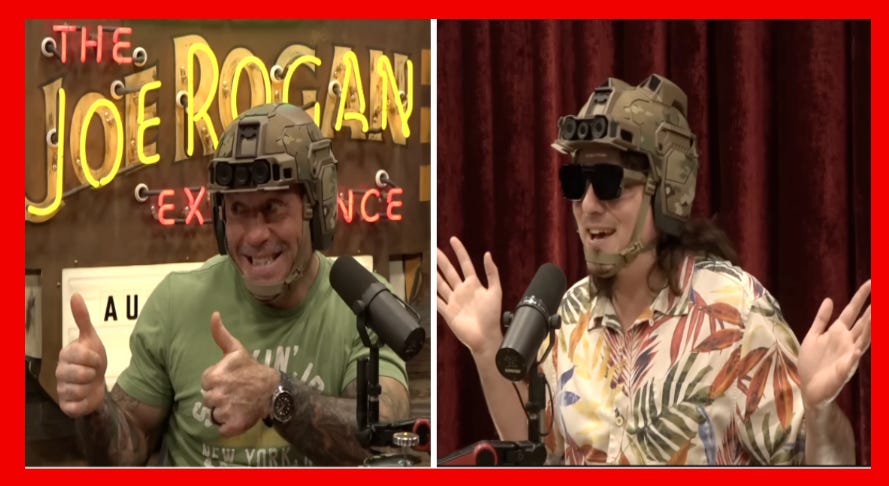
UNASB made its annual pilgrimage to the Joe Rogan Experience, where we got a deep dive into the tech right’s worldview through the guest, Palmer Luckey.
Luckey is a tech billionaire who invented the Oculus Rift virtual reality headset which was acquired by Facebook (now Meta) in his early twenties. He was fired from Facebook (or was asked to leave or mutually separated, depending on who you ask) at 25 for making a $10,000 donation to a pro-Trump group that ran a “Too Big To Jail” billboard with Hillary Clinton’s face and other anti-Hillary memes during the 2016 election.
Now in his thirties, Luckey runs the weapons and tech manufacturer he founded, Anduril Industries, which has made millions from government contracts and is even more entrenched within the tech right network. Anduril received initial investments from tech right figurehead Peter Thiel, and the company’s early staff included former executives from Palantir, Thiel’s technology and surveillance company.
Rogan and Luckey’s conversation runs for over three hours, and it feels like two dudes hanging out and talking about whatever pops into their minds next. Still, the episode works to paint Luckey as a righteous boy genius living at exactly the right time to use his talents to become massively wealthy and help his country in the process.
Joe Rogan Experience #2394 - Palmer Luckey
Throughout the podcast, Luckey makes specific cultural references — from sci-fi shows to video games to his company Anduril itself, which is named after a sword from Lord of the Rings — that provide a window into the kinds of media that are resonating with a cohort of Millennial and Gen-Z young men. Rogan (who seems to have more bro-y cultural touchstones), doesn’t quite match Luckey’s enthusiasm at all times, but the two talk about The X Files, conspiracy theories, Star Trek, video games, robot battles, talking dogs, and more. These references could get very niche (this nerdy recapper clocked that Luckey was name-dropping a Yu-Gi-Oh character as a fictional technologist he admired without Luckey even naming the anime series itself), but they were mostly from mainstream, not right wing, media.
Luckey still works in conservative talking points into these pop culture discussions, though. He praises Warner Bros. for announcing they will make movies people want to see, and not what he calls “art house social justice money losers” (notably, he doesn’t say ‘woke’). He never uses the actual phrase “DEI,” but he uses a heavy-handed metaphor about choosing the best ratio of men’s to women’s bathrooms in a new office building to ‘prove’ that working towards more gender diversity in male-dominated fields like video games is undeniably stupid. Rogan nods along.
Luckey’s portrayal of his career (and the worldview he developed through it) also consistently reinforces the tech right’s narratives. Luckey celebrates the role of weapons manufacturers and defense contractors as a way to live out his boyhood dreams, gamifying war so it doesn’t feel like it has life-or-death stakes. He breezes past the fact that he’s made billions from government spending and military contracts, describing it as more efficient cost savings. He even says making instruments of war is the morally righteous thing to do (because if a moral person doesn’t make the weapons, someone else will), adding that the best role for the United States would be “to become the world’s gun store.”
And then there’s the actual politics talk. A tangent that starts with Rogan and Luckey talking about the Gulf War ends with them agreeing that Trump is the only man alive who could withstand the physical pressures of the presidency, and they’re off to the races. Luckey shares a story about Clinton advisor John Podesta refusing to answer a straightforward question in a meeting with potential donors in 2015, citing that exchange as the moment he fully turned against the left. Then he talks about how he’s been a longtime Trump supporter by 2016, claiming credibility as both a converted liberal and a Trump fan ahead of his time. Rogan and Luckey may gesture at being independent, but through it all, they are unabashedly pro-Trump, anti-Democrat, and certainly anti-liberal.
Key Takeaways
Luckey presents himself as the (pun intended) luckiest guy in the world. He’s born at exactly the right time to take his childhood love of sci-fi, his self-proclaimed brilliance, and the government’s desire to pay for new weapons in order to get rich doing what he loves. In this way, he gives young men who might not have Rogan’s brawn but Luckey’s brain a future to aspire to —a future that still leads them to the right.
Luckey claims to be the source of truth — both intellectually and morally —without qualms or caveats. He says without batting an eye that the best choice for smart, moral people is to go into weapons manufacturing. He’s convinced that independent corporations should be the only ones making military technology. He’s even got an unimpeachable read on the British psyche and Chinese acceptance of surveillance. Rogan rarely pushes back or asks follow-ups; Luckey is able to hand-wave his source for some military knowledge with an “I can’t tell you how I know that,” and the conversation moves on to another area of Luckey’s expertise.
Luckey finds just enough points of disagreement to paint himself as an independent, credible voice. He calls himself libertarian, doesn’t think the state should be involved in regulating marriage at all (gay or otherwise), and even references a time when he used to work with a liberal nonprofit. He even breaks with other tech-right thinkers by criticizing government surveillance and censorship on social media, and by saying he does think foreign policy decisions should be made by an elected official, not a corporation. Rogan takes these departures from expectations as adding credibility, not marks against it.
Rogan isn’t fully sold on the tech right’s post-human fantasies. While Luckey hypes up robot-on-robot boxing matches (and his long-term backer, Peter Thiel, isn’t convinced the human race should endure at all), Rogan would rather use AI to help humans box better instead. He also seems bored during some of Luckey’s nerdier tangents, suggesting this jock-nerd alliance isn’t fully locked in.
What we (left-leaning people) can learn from this and DO
We can find common ground for conversations with people who are compelled by the tech right, through critiques of bloated military spending.
Luckey, who directly profits from government defense contracts, is willing to say that America’s defense spending is bloated and inefficient. This could be an inroad to talking more about reprioritizing massive military budgets. It could also be an opportunity to talk about what the government is NOT spending money on, like making medication more affordable, fighting monopolies, improving education, or keeping our air and water clean.
Present a compelling vision of the future, and inspire tech innovators to help us make it possible.
Luckey offers a clear, supposedly utopian future through tech. It’s one where we can talk to our dogs thanks to AI, where drones are constantly monitoring to detect and stop wildfires before they get a chance to spread — and yes, where the brightest minds have made the United States the gun store of the world. If we want to bring more people onto our side, we have to give these potential innovators a different vision to work towards. Instead of weapons, what should we be creating? The Abundance-left paints a picture of America with towers of housing, freely available clean energy, and thriving innovation. How can other factions of the left improve their own worldbuilding in the public consciousness? Whatever future vision you may have, talk about it often and in tangible ways, and invite more people in to help you make it real.
Faith is still an important battleground, even with the tech right.
In one of the more surprising moments, Luckey talks about how AI and technology go hand in hand with his devout Christian faith. His faith gives a purpose to his billions and his mission, and AI shows that man can also create something in its own image. Could there be better answers from the left for people asking these same questions?
We have to do better about engaging sci-fi and fantasy fan cultures.
Reading Lord of the Rings or watching Star Trek doesn’t automatically make you conservative — just ask Stacey Abrams (or your recapper, who dressed up as J.R.R. Tolkien for a fourth grade biography night). The left has made some inroads here, like making DC Comics’ Nazi-fighting G.I. Robot into a symbol of anti-authoritarian resistance online, but there’s more work to be done. This fan engagement also needs to be authentic, instead of just playing Madden a week before Election Day to try and reach some gamers. There will always be a contingent of trolls mad about casting a woman or non-white Star Wars character, but there are plenty more apolitical fans out there to find common ground with and bring to our side, too.
WHAT UNASB MEMBERS ARE READING:
Christian nationalist pastor speaks on his sermon to troops at Pentagon
What the Left Can Learn From A MAGA–Adjacent Christian Streaming Service
MARK HALPERIN: Trump strategy super session plots midterm survival as history stalks GOP
‘The right has won the family’: my relentless search for lefty mommy bloggers
Thanks for reading! Want to get involved? Click here.

Excellent summary of a long and meandering conversation. I appreciate how you pulled out the key threads rather than listing every off-topic tangent. Thanks also for framing it through a strategic lens.
I read elsewhere that Luckey appeals to a lot of people simply because he builds undeniably ‘cool toys’ — cutting-edge hardware and defense tech that feel futuristic and cinematic. That aesthetic and energy has cultural pull beyond ideology.
I wonder if people who are genuinely compelled by tech coverage aren’t locked in solely because of politics. There may be a shared interest in the future of human capability, and problem-solving. That’s a solid starting point for dialogue rather than assuming bad faith or caricaturing the audience.