

The Purity Culture Pipeline Bringing Women into the Right Wing Media Ecosystem
OUT: Pop Culture, IN: Purity Culture – Allie Beth Stuckey's playbook to funnel women into the MAGA movement

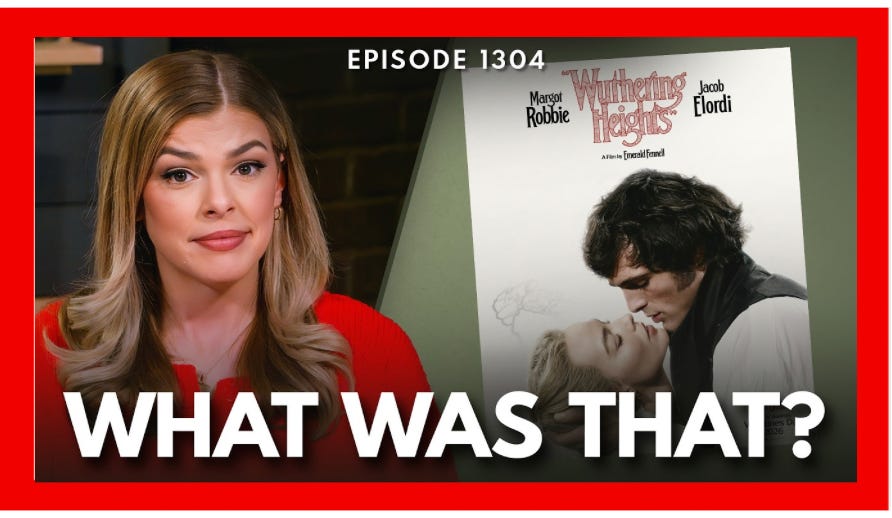
Welcome back to UNASB! This newsletter serves as a recap of our last meeting. As a reminder, here at UNASB, we listen to conservative-leaning podcasts, analyze their messaging and themes, and brainstorm actionable ideas for how the Democratic coalition can strengthen our approach.
The Right Wing’s use of cultural commentary as a tactic to funnel new audiences into the MAGA-aligned media ecosystem is something UNASB has come to understand well. We’ve examined how this works to target young men; last week, we turned our attention to how it operates on women, leading with moral concerns and values-first messaging before pivoting to ideology.
The episode: Relatable with Allie Beth Stuckey’s Episode 1304 | ‘Wuthering Heights’ Movie is NOT What I Expected.
The messenger: Allie Beth Stuckey is a podcaster on Glenn Beck’s network and author of the recent New York Times bestseller ‘Toxic Empathy: How Progressives Exploit Christian Compassion,’ which frames progressive appeals to compassion as dangerous manipulation tactics. A Conservative Millennial, wife, and mom of three, Stuckey operates at the intersection of politics and Christian theology. She has 722k YouTube subscribers and 900k Instagram followers.
In the episode, Stuckey critiques the recently-released film ‘Wuthering Heights’ and contemporary pop culture through the lens of Christian womanhood and purity culture, taking aim at Bridgerton, Taylor Swift, Twilight, among others. Notably, Stuckey’s discourse around ‘Wuthering Heights’ seems to imply that she has not actually watched it.
Note: Stuckey’s advertisers—pro-life diapers marketed as “knowing what a woman is,” crisis pregnancy centers, prepper supplies that shift responsibility for family protection from state to individual—explicitly reinforce the worldview she proselytizes.
Key Learnings & How to Use Them
Values-first messaging is a gateway
Stuckey leads with appeals to shared moral concerns: gender-based violence in media, the impact of hyper-sexualization on young women, and the toxicity of patriarchal control in romantic relationships. This approach lets listeners first agree with her moral premise without realizing they’re being moved toward a particular political worldview.
She never mentions being “Republican” or “conservative,” never invokes the boogeyman language of “the left” or “Hollywood elite.” By avoiding partisan language, she sidesteps barriers many people put up against political messaging. A mother concerned about media’s impact on her child, or a young woman worried about a romantic relationship, finds herself in genuine agreement, then gradually absorbed into an ideology that systematically undercuts women’s agency and autonomy.
Making it actionable
This is how moral foundations function: start with a shared truth or moral concern (sexualization of children, social media harms kids, media depicts violence) that activates a core moral intuition, then bring politics in through that foundation. The Right does this well, whereas the Left tends to lead with policy. We can compete on this terrain, but we have to arrive there through a moral frame, one that actually expands agency. This UNASB op-ed is essential reading to understand how: Before the Argument, There is an Instinct.
One obvious place for the Left to lean on moral foundations? Widespread outrage and disgust over the Epstein files. Stuckey references the scandal directly, describing it as ‘the reality of evil…being perpetrated against the most vulnerable’, indicating her audience is already engaged with and disgusted by this story. We can leverage the same moral intuitions—disgust towards the perpetrators, an instinct to protect the most vulnerable from harm, a desire for justice on their behalf—by continuing to demand transparency and accountability for those responsible, including the many perpetrators with ties to the Trump administration.
Accessible language and scripture mimic connection
Stuckey opens with scripture, then positions herself as a relatable older sister who, in girlhood, was also led astray by mainstream culture (Taylor Swift’s “Fearless” album, the Twilight series), but ultimately saw the light and wisely chose a different path. From the spiritual communion of sermon to the intimacy of girl talk, Stuckey speaks directly to the longing for meaning and belonging that people feel so acutely today, in an increasingly atomized and lonely world.
Stuckey also offers community in a space that affirms her listeners’ feelings of overwhelm. She offers them in-group membership as part of, for example, the “never watched Bridgerton” club. For that in-group to exist, there must also be an out-group: those consuming different media, who by extension have different values, and are thus morally compromised.
Making it actionable
We must speak to people’s hunger for meaning, belonging, and relational connection. Language that speaks to people on a human level—to their hearts and souls, not just their heads—is one way to do that.
We can also reframe what the actual threat is. The Left has an opportunity to offer the same sense of in-group belonging, but around a shared enemy that’s actually harming regular working people: tech billionaires, the Epstein class, corrupt politicians. We can create a “we” that’s defined by who we’re protecting ourselves against.
The appeal of benevolent patriarchy as God’s eternal plan
Stuckey’s message resonates because it acknowledges real pain: women’s fears of being alone, alienation from modern culture, uncertainty navigating modern dating and anxiety around partnership. Her refrain “God’s eternal plan is going off without a hitch”, which was mentioned frequently by listeners in the comments section, extends grace even to women who’ve “failed” the purity culture script.
However, she exploits this pain. After making her listeners feel heard and understood, she shifts toward benevolent patriarchy and purity culture as the solution to their problems—or at least a salvation from worrying about them. She reframes self-knowledge as selfish narcissism and lowered expectations of romantic partners as spiritual maturity. She presents this as protecting women, but in reality, it restricts them.
It’s notable how this mirrors Stuckey’s critique in Toxic Empathy that progressives use appeals to compassion as manipulation. She deploys the same tactic here, gently and compassionately addressing real fears, then presenting solutions that ask women to accept less.
Making it actionable
Stuckey’s vision has a critical weakness: it offers no agency. She tells women what to avoid, what not to consume, but she doesn’t offer them anything concrete to do. No path forward, no aspirational vision. This is a weakness the Left can leverage. We have an opening here, to offer women solutions that are aspirational and involve real agency and real choices.
WHAT UNASB MEMBERS ARE READING
What Love is Blind: Ohio Understands About the Rust Belt That Democrats Don’t
‘You unbelievable coward’: conservative US media in open warfare over Iran
Hasan Piker: ‘The left should be better at manufacturing outrage’
‘Nazi heaven’: Inside Miami campus Republicans’ racist group chat
Inside the secret meeting that led to the AI political resistance
Thanks for reading! We’re currently accepting new members into our 5th (!!) cohort starting in April. Sign up here!
 | A guest post by
|
Jenica, very good writing.
Stuckey is effective precisely because she never sounds political — she sounds like a concerned older sister. Real moral framing, relatable language, genuine community, all smuggling in an ideology that strips women of agency. Almost like an undercover agent
The Left keeps bringing policy briefs to a sermon fight.
The Epstein angle is the clearest example of a missed opportunity. That story hits every moral instinct — disgust, outrage, protection of the vulnerable, demand for justice — and our elected officials and candidates have largely fumbled it because they offer no specifics on moving forward to better prevent, identify and prosecute human trafficking, while highlighting Trump cuts into those very areas.