

CLUB RECAP: MAHA’s yearly checkup
What one year of MAHA tells us about movement-building in health

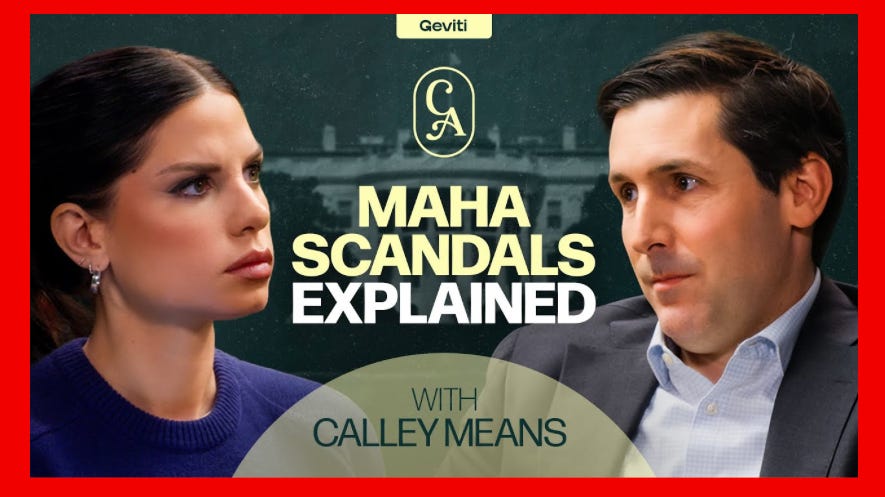
Welcome back to UNASB! This newsletter serves as a recap of our latest meeting. As a reminder, here at UNSAB, we listen to right-leaning podcasts, analyze their messaging and themes, and brainstorm actionable ideas for how the democratic coalition can strengthen its own approach.
UNASB turned our attention to the Make America Healthy Again (MAHA) movement, which has been a major conversation driver of that has moved health-conscious voters to the right. There’s no better place to start analyzing the MAHA movement from within than through Alex Clark’s Turning Point USA-backed podcast Culture Apothecary.
The health and wellness-focused podcast with half a million subscribers touts its mission as providing a space where “each guest provides their own remedy to heal a sick culture - physically, emotionally, and spiritually.” The message is stickier than ever– more than70% of her audience in the past year are new listeners.
The selected podcast episode, “Debunking MAHA Lies and Explaining Year 1 Trump Controversies,” features Calley Means, a current HHS senior advisor, wellness entrepreneur, and brother of Trump’s nominee for our country’s next surgeon general.
The conversation was far-ranging, covering topics such as vaccines, pesticides, infertility, and public nutrition assistance. There are repeated references to how untrustworthy food companies and medical experts have become. Means describes MAHA’s success as a “cultural transformation” around health. He tempers expectations of radical, immediate change by offering a parallel to the decades-long mission to overturn Roe v. Wade. He explains, contrary to the evidence, that “research has not been cut”, and instead promotes how MAHA is investing heavily into cancer, microplastics, testosterone, and “food as medicine” research. Means also celebrates major MAHA wins like removing soda and candy from SNAP.
Throughout the podcast, there were many calls to action. Listeners were encouraged to call their lawmakers about food label reforms, send the podcast to a liberal in their life, and question their pediatricians about their children’s prescriptions. The message was clear: MAHA isn’t just policy, it’s a well-organized cultural revival.
Key Takeaways
Health is an effective political conversion tool.
Mothers and families feel overwhelmed by the costs and conflicting information each time they visit a grocery store or doctor’s office. MAHA offers individuals something that looks like personal empowerment, which is so much sexier than believing that the government is invested in the public good. Once you’re in the MAHA movement, you’re part of a community of logical, empathic individuals who are seeking a healthier future, and crucially, you should do everything in your power to support MAGA so that the momentum continues.
Simple is good.
Both Means and Clark emphasize non-controversial, feel-good solutions to complex health issues. Eat more whole foods. Get some sunlight and lots of exercise. Brushed aside are how socioeconomics affects access to these factors, or how well-researched western medicine practices do have their place for those patients who need it.
The right is effective at turning the speaking points of the left around.
The promotion of equity is portrayed as opposite to logic. Public health nuance that takes affordability and equity into account is reduced to claiming that promoting whole foods is racist. Ultraprocessed foods are cast as a construction of the left. “They accuse us of being sexist for suggesting that moms should cook whole food for their kids.”
Trust in medicine, government, and research is incredibly low, and the right does not expect this to change.
Instead, they are planning incremental changes over the next few decades to radically upend what healthcare means in America. Under this system, short-term policy losses are to be expected. They are priming their audiences for the long game.
Making What We Learned Actionable
Fact checking isn’t enough.
MAHA is selling a message of a stronger, healthier, and cheaper future. The left needs to move towards a framework where public health helps you thrive, not just protects you from harm.
MAHA invests in speaking to moms and influencers directly.
The left communicates top-down. By investing in direct storytelling from families or communities, the left can make its message more relatable and accessible.
The rise of MAHA comes from its relatable identity as a group of individuals and families concerned about their health and seeking a system that’s easier to understand.
If Democrats want to compete, they need to build an equally compelling vision of an America where good health is easy and empowering. Cultural movements win when they make people feel strong.
WHAT UNASB MEMBERS ARE READING
The Dizzying Rise of MAHA Warrior Calley Means, RFK Jr.’s Right-Hand Man
Built for a Different War: Why Progressive Institutions Can’t Compete in Today’s Media Battlefield
Thanks for reading! Want to get involved in UNASB? Click here.
 | A guest post by
|
Great recap — MAHA has shown real skill in shaping narrative and reaching diverse audiences, even as its ideas and claims are contested. MAHA and Trump have been successful in 'hijacking' values from the left of center. Can you share examples of anti-MAHA leaders — political or civic — who have adopted stronger PR approaches in response, and how that pushback is playing out?