

CLUB RECAP: Ignoring war, overzealous confidence, and focusing on what really matters: aliens & demons
Presenting as the voice of reason and cherry picking context to shape a narrative: lessons learned from Michael Knowles.

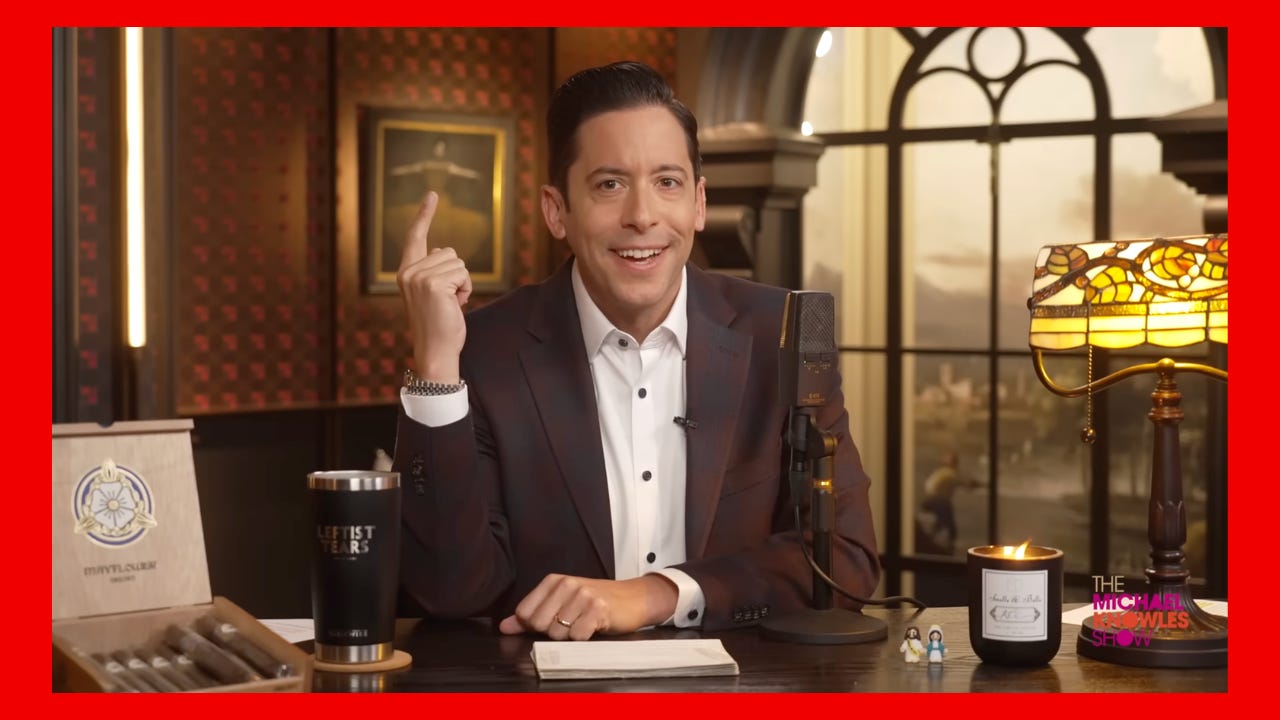
Welcome back to UNASB! This newsletter serves as a recap of our last meeting. As a reminder, here at UNASB, we listen to conservative-leaning podcasts, analyze their messaging and themes, and brainstorm actionable ideas for how the Democratic coalition can strengthen its own approach.
UNASB recently listened to episode 1945 of the Michael Knowles Show, “BREAKING: Trump Fires AG Pam Bondi.” We explored the messaging tactics Knowles uses to bring his audience along, including invoking religion as a source of moral authority, repetition and compassionate coercion (gently bullying his audience into agreement), perceptions of Americans and “Americanness,” and attacks on the Supreme Court.
The Episode: BREAKING: Trump FIRES AG Pam Bondi
The Michael Knowles show is part of The Daily Wire, a far-right media house founded by Ben Shapiro and home to other popular conservative podcasters including Ben Shapiro himself (“The Ben Shapiro Show”) and Matt Walsh (“The Matt Walsh Show”). While The Daily Wire’s podcasters each have their own distinct voice, there is an undeniable undercurrent pulling all of the aforementioned shows in the same direction: institutional voice.
It’s not uncommon for one podcast host to feature another Daily Wire podcaster as a guest. It’s also not uncommon for themes and specific talking points to reappear, over and over again. This is true despite the fact that Matt Walsh, for example, disagrees with the war in Iran, while Michael Knowles and Ben Shapiro both support it. They have intentional, scripted conversations, featuring polite debate over this disagreement while presenting a united front against what they view as the “real threats” to America: Ketanji Brown Jackson (the only Black woman to ever sit on the Supreme Court), trans people, the lower federal courts, unmarried women, Democrats, the educated “elite,” and anyone who isn’t Christian.
This episode bounced from topic to topic at warp speed, so buckle up.
Helping Create Distance between Trump and the administration’s “weak links”
Knowles kicked off the episode by tap dancing around the recent Trump firings of Pam Bondi and Kristi Noem. He framed the firings as unnewsworthy, calling them “unsurprising” and referring to Bondi as the “weakest link.” In a maneuver Knowles proves expert at, he simultaneously applauded Trump for his discipline and restraint while condemning the administration’s most senior officials. While Knowles didn’t directly address gender in reference to Bondi and Noem’s firings, he did comment - in his own comments section for this episode - that “[a]ll of the other women in the cabinet are starting to get nervous.” The math is in fact mathing.
In other noteworthy news Knowles glossed over, the war in Iran was not mentioned once in this episode.
The Liberals aren’t sending their best: Creating a facade of neutrality
Michael Knowles and his Daily Wire compatriots spend a lot of time talking about Ketanji Brown Jackson. In this episode, Knowles went all the way in on Justice Jackson.
What starts as a bumbling explanation of English Common Law and its foundational connections to present-day birthright citizenship in U.S. jurisprudence quickly turned into, well, whatever this is:
“Ketanji Brown Jackson, a woman who during her confirmation hearings could not tell Senator Blackburn what a woman is . . . .”
“Ketanji Jackson, arguably not the most qualified jurist we’ve had on the Supreme Court . . . some would say, not the brightest bulb in the candelabra . . .”
Knowles continues this while “analyzing” the Colorado “Conversion Therapy” case, also currently before the court:
“[T]his woman’s arguments are ridiculous.”
“Elena Kagan, a very leftwing member of the Supreme Court, was mocking Justice Jackson’s arguments in this case.”
“This woman just has no grasp on the law.”
“Ketanji Jackson has no grasp on the law.”
“She has no grasp on formal logic or informal logic.”
“She clearly doesn’t understand the matters that she’s supposed to deliberate on.”
“Indeed, she doesn’t understand what a woman is.”
“[I]f you had a court full of Ketanji Jacksons, American jurisprudence would be shredded.”
“[T]he scary thing is, especially if we have a Democrat president in 2029, you’re going to get more Ketanji Jacksons.”
“There is no comparison between a Ketanji Jackson and an Elena Kagan, or even between a Ketanji Jackson and a Sonia Sotomayor….”
“The Supreme Court is supposed to be rock solid. And when you[] fill the Court up with Ketanji Jacksons, that’s going away.”
Your eyes are not betraying you. Knowles said all of these things about Justice Ketanji Brown Jackson in a single episode.
Knowles goes as far as saying that the Solicitor General, the man responsible for arguing the birthright citizenship case on behalf of the Trump administration, “ha[d] to go in and describe what everybody always knew . . . and explain what domicile meant and what all of these legal terms meant in the 19th century.” He’s nudging his listeners to believe that Justice Jackson, a Yale-trained attorney who graduated at the top of her class and spent more time as a federal judge prior to her appointment to the Supreme Court than any other current Supreme Court Justice, does not understand the law.
Following this scathing tirade about Justice Ketanji Brown Jackson, it is somewhat surprising when Knowles concedes “I’m actually somewhat sympathetic to Ketanji Jackson here,” referencing the Supreme Court concept of “viewpoint neutrality,” which Knowles describes as “silly.” This is a key strategy for Knowles, as demonstrating his ability to relate to his enemy serves to strengthen his credibility. This sympathy, however, is feigned. Only a few moments later, Knowles declares “this woman’s arguments are ridiculous.”
Knowles had very little to say about the merits of either of the cases actually before the court. He spent most of his time vacillating between directly stating that Ketanji Brown Jackson is unintelligent and unqualified or insinuating as much.
This segment of the episode also proved a masterclass in fear mongering. While painting conversion therapy as not only normal, but desirable, Knowles relied heavily on populism. This divide and conquer tactic is a common mechanism for Knowles and other conservative podcasters. They create an “us” and a “them” and diligently invest in that division both within and across episodes. They tell us who is a “good American” and who is not. Spoiler alert: the LGBTQIA+ community, undocumented immigrants, Democrats, and Justice Ketanji Brown Jackson are on the naughty list.
UFOs, Aliens, and . . . Demons? Oh my.
“Extraterrestrial human breeding programs” . . . he said what he said. A major theme in this episode of the Michael Knowles show was aliens. At first listen, he seemed to be knowingly throwing a conspiracy theory into the ether just for funsies. However, as we unpacked in our most recent meeting, the religious undertones surfaced quickly.
After playing sound bites from recent conversations in congress surrounding aliens, the military, and how the military is allegedly perpetrating an alien sexual assault ring, Knowles shifted seemlessly into a discussion on demons.
He claims that these aliens are actually demons, in the religious sense. They don’t necessarily occupy space and time as we might expect them to. They are a demonic creation. And, in a rhetorical device he reaches for with regularity, he gently bullies his audience into agreeing with him, saying his listeners “should” believe in demons, angels, and immaterial substances. It’s common for right-wing podcasters to exploit a divide, a fear, and a pull toward the unknown. Keep an ear out for this tactic as you listen to these voices.
“I pick the least popular view on anything, that’s how you know I’m right.”
Knowles has a veritable grab bag full of tactics that he engages with impressive ease to cajole his audience into trusting him and everything he is saying. He deploys repetition deftly, saying the same phrases and repeating the same rhetorical questions over and over again. He says things like “can we all agree on this” and “Can we acknowledge that this is a problem? Can we acknowledge that this is a serious problem?”
After a brief commercial break to push beef tallow as the best facial moisturizer, he returns and repeats the exact same phrase: “Can we acknowledge that this is a problem?” leaving the listener to feel like the only reasonable thing to do is agree that this is in fact a problem. Knowles is carefully constructing an image of himself as the voice of reason, in turn anyone who disagrees is inherently crazy and unreasonable.
Knowles sprints from topic to topic in a way that leaves the listener gasping for air and with little time to think critically.
He crumbs the listener to the “truth” he wants them to believe by sandwiching factual, provable information between thick slices of ahistorical and untrue information. He taps into fear and uncertainty, repeatedly honing in on how scary the Supreme Court has become, and how much scarier it will be when it is full of Ketanji Brown Jacksons at some future time that he cannot name but assures us will come.
KEY TAKEAWAYS
Better Not to Address the Elephant in the Room if it Complicates Your Argument.
Michael Knowles covers everything from anchor babies to alien demons and yet he fails to mention the heavily controversial War in Iran. By refusing to dig into this issue, Knowles is freeing himself from any need to question Trump’s actions or take a clear stance on an area that conservatives have very conflicted opinions on.
Admitting when you agree with the other side builds credibility.
Even when it comes to people we feel are completely morally opposed to us it is worth taking the time to find that ONE point of intersection. Not only does this serve as a bridge to the other side, it demonstrates that you are actually listening to their argument as opposed to rejecting everything they say at face value.
Presenting your argument as the voice of reason.
The phrases “can’t we agree” and “it’s kind of silly” are repeated over and over again by Knowles. This is powerful because it devalues the left in a tongue-in-cheek light hearted way. Scathing criticism is replaced with a sly smirk and witty line, undermining the other side without coming across as too serious or overly critical. Without any opportunity for response these rhetorical questions present all of Knowles’ arguments as unquestionable and even common sense.
Repetition.
Knowles’ presentation of his arguments as “objectively” reasonable is made all the more convincing by his use of repetition as a tool. He repeats the same phrase over and over again, sometimes both before and after a commercial break, other times just several times in a row. It eventually has the effect of either making the listener question whether he might be on to something, if not believing it outright.
Using media from the other side as evidence for your claims.
By pulling from a CBS clip and providing his own context for it, Knowles is highlighting that his perspective can be trusted. While his arguments might be better supported by right-wing media sources, he is appealing to a wider audience by demonstrating he can prove his point from either side.
Using more palatable people from the other side as foils.
Knowles repeatedly uses liberal Justices Elena Kagan and Sonia Sotomayor as tools to make Justice Ketanji Brown Jackson seem patently unreasonable. He employs the same tactic when he disagrees with conservative Justices in other episodes, portraying Justices Clarence Thomas and Samuel Alito as tried and true conservative heroes while depicting Chief Justice John Roberts as useless.
WHAT UNASB MEMBERS ARE READING:
Thanks for reading! Want to get involved? Click here.
 | A guest post by
|
Thanks for the summary. There’s a familiar pattern here: coordinated “debate” that never strays from a shared conclusion, reinforcing an institutional voice shaped by figures like Ben Shapiro, while including CBS (MSM) sources. Michael made sure listeners heard that firings were predictable, even justified. From Trump on down, he employs subtle and not so subtle character assassination—“weakest link,” “unsurprising”. That framing protects power while distancing failure. Just as telling is the selective use of opposing media as “proof,” lending credibility while distorting context. Even the ironic turn to “aliens” as casual, relatable content broadens reach while normalizing the tone—softening the seriousness of real events—paired with a confident insistence on always being right.