

White Nationalism Isn’t Just For White People
Why Latino men are drifting toward right-wing pipelines and how we bring them back


A Vibe Shift
There’s this group chat that has always been a safe haven for me. They’re some of my primos, childhood friends, friends from work, coworkers, and guys I’ve met along the way. There’s about twenty of us who are all children of immigrants, share the same Latino values and upbringing that comes with being first-generation American. Our chat has always been unserious and lowkey: memes, Dodgers talk, complaining about life, and setting up kickbacks.
Then, it happened.“Women don’t want it anymore.” A seemingly small comment about the perils of dating apps. At first, that comment went unnoticed and the chat continued like normal: complaints about life, funny memes, and shit-talking. Then, it happened again. Some commentary on how “girls have changed” and how they don’t want guys who “work-hard and provide for their families” because they just care about “their careers.” Slowly, the conversation picked up. My friends agreed and showed love for some of the comments.
Over time, my safe group chat became infected with memes from creators like Adin Ross, Sneako, and Clavicular—influencers in the white-nationalist pipeline. The conversation started with dating, something called “looksmaxxing,” and girls. It was supposed to be funny. Sharing the videos in an ironic way, to share that we knew better. It didn’t stay that way.
Soon, videos of Andrew Tate—an influencer who uses his tight suits, fast cars, and beautiful women to talk about how “real-men” should act even if it means embracing white nationalism—began popping up and no longer ironically. “It’s the end of Western values,” Tate said, in one of the videos shared. “[Immigrants are] destroying our culture,” he continued. There it was, tucked between jokes and sports-talk, my friend lamented, “things aren’t the same anymore . . . we’re losing our place.” Others showed him love with tapbacks and reactions. “He’s not wrong,” one of my childhood friends said. I was shocked. Even something as simple as a “like” or “emphasize” felt like a dagger through the heart of our relationship.
My group chat was now a safe haven for white-nationalist ideas.
“[Immigrants] are the reason why I can’t afford a home. They come over here just to take up all the housing. We need to do something about it,” my friend said. Nobody pushed back and a few even agreed. Childhood friends and family, all Latinos who grew up with me, were using white-nationalist language and blaming immigrants for high costs and lack of housing. I really didn’t see it coming and I didn’t know how to respond. I felt angry, betrayed, confused. How did men whose parents crossed borders; who grew up translating bills at the kitchen tables; who know what it feels like to be “othered,” start nodding along to these ideas? How could they say immigrants were the source of all their problems when they were the children of immigrants?
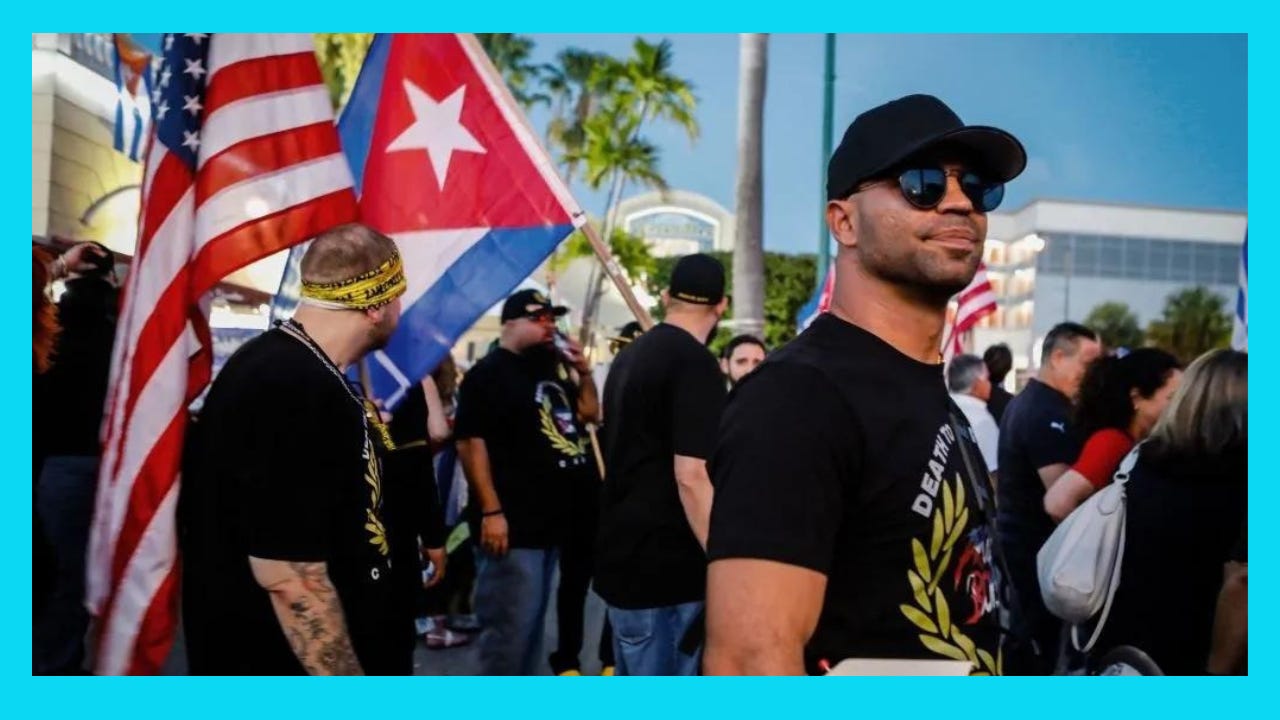
My friends aren’t alone. There is an epidemic of Latinos falling into the white-nationalist pipeline. Guys like Nick Fuentes, a groyper and self-proclaimed Nazi and Henry “Enrique” Tarrio, a Cuban national and former chairman of the neo-fascist Proud Boys, are convincing Latinos to drift towards ideas that don’t seem built for our community. What is it about these ideas that resonate with Latino men? And more importantly, how do we talk about it without losing each other in the process?
It’s Personal, Not Politics
If we’re going to have an honest conversation about why some Latino men are pulled into white-nationalist spaces, we have to start with ourselves. As Latinos, our moms all said it growing up, “dime con quién andas, y te diré quién eres.” It means, “don’t hang out with the wrong crowd;” “don’t let bad influences shape you;” “tell me who you’re with, and I’ll tell you who you are.” Today, I know that this advice was not about judgment but about formation. Community is not just who you spend time with physically. It’s also your algorithm, twitch streams, podcast queues, and yes, your group chats. The people we listen to, the content we consume, and the voices we trust all begin to define what we think is normal, true, and who we see as “us” and “them.”
Many Latino men aren’t waking up one day and deciding to adopt white-nationalist ideas, but they are inundated by white-nationalist content that appeals to their underlying Latino values.
Traditional Latino values are built on faith, family, and hard work.. From birth, men in our culture are taught about the importance of being traditionally masculine—“machismo.” We are required to work hard, be the bread-winners. We are taught that women are the “homemakers” who are “softer” and more emotionally intelligent. These gender norms are embedded in traditional Latino culture, regardless of whether you agree with them. We are supposed to be stoic, steady, and strong. Anger is the only masculine emotion.
Latino culture is also heavily informed by our faith. We are taught traditional Christian values from a young age, which forms the basis of our families and our political stances. From abortion to LGBTQ rights, we’re taught to embrace tradition and reject progressive stances in politics.
Latino men are not drifting because they are lost causes but because they are searching for dignity, belonging, and respect. When familiar values and beliefs are warped and weaponized, parts of our identities feel unseen. When our values are warped, it creates openings that others are ready to fill.
You’re One of the Good Ones
There is also a quiet unspoken tension that exists within this conversation: for generations, many Latinos in the United States have been navigating identity with proximity to whiteness. In other words, whiteness is aspiration. It means access, being welcomed into storefronts rather than followed, getting the benefit of the doubt from a cop during a traffic stop. Doors open a little easier, conversations go a little smoother, and assumptions work in your favor.
Historically, the U.S. was legally binary on race: you’re either black or you’re white. For decades, the census lacked a “Latino” or “Hispanic” category, requiring Latinos to be classified as white. This meant access, at least in theory, to the rights afforded white Americans: citizenship, property ownership, and so on. White on paper, yet still segregated at work and school, denied jobs and housing, subject to violence and discrimination. That confusion created a long-standing dynamic where assimilation into whiteness became a pathway to safety: if I am white, I am safe. Therefore, I must assimilate to whiteness.
Many of us have seen this play out in real time—family members encouraged to “speak English without an accent,” to “dress a certain way,” to “blend in” so they’re taken more seriously at work or in school.
“Whiteness” has never just been about skin color: it has been about access, safety, and belonging. In a country where those things are not evenly distributed, that proximity can feel worth chasing.
This assimilation was a means of survival. It meant new immigrants must speak English without an accent; adopt certain cultural norms; and distance themselves from anything that could mark them as “other.” Davey Lopez (“Loh-Pehs”) became Davey Lopes (“loh-ps”), Ramón Gerard Antonio Estévez became “Martin Sheen;” Margarita Carmen Cansino became “Rita Hayworth;” Manuel Antonio Rodolfo Quinn Oaxaca became “Anthony Quinn;” and so on. These were not moral failings or rejections of Latino identity, but instead, strategies in a system that rewarded proximity to power. These strategies were birthed out of a necessity to navigate American life: a white tree, growing from brown soil.
So when certain spaces, even right-wing ones, offer a version of belonging that feels closer to safety and belonging, even if it’s conditional, it’s seductive. It can feel like finally stepping into a version of America that works for you. The problem is that this kind of belonging is never neutral and never guaranteed. It asks you to distance yourself from others, to adopt a hierarchy that was never built with you in mind, and to trade solidarity for a seat that can be pulled out from under you at any moment.
Today, this tension continues. When white-nationalists say “you’re one of the good ones,” they’re tapping into an idea that has existed for generations: whiteness is safety, and belonging is conditional. For Latino men raised with a strong emphasis on work, discipline, and responsibility, this messaging feels familiar—if you do everything right, you will be accepted; if you separate yourself from the “problem,” you will be included. White-nationalist narratives exploit that feeling, warping those underlying values to serve their own ends. The offer of proximity to power—however temporary—is especially potent for men who have felt ostracized, invisible, and disrespected in this country. But that inclusion is fragile and reversible. When lines get redrawn, those closest to the margins are the first to be pushed out.
Old Biases, New Uses
The pipeline does not have to invent new biases. Instead, it need only tap into ones that already exist quietly, unevenly, and across our communities: colorism, anti-Blackness, erasure of Indigenous communities, homophobia, and transphobia. White nationalists may not name these dynamics directly, but they do signal and build on them. They take what might exist as a passing comment, a cultural norm, or an unchallenged assumption and give it direction. A joke about darker skin tones becomes a hierarchy about who is more “acceptable.”
Pride in assimilation evolves into distance from newer immigrants; “I did it the right way” we’ll say. Respect for tradition becomes policing gender and sexuality because “that’s not how we do things.” Slowly, what might have been contradictions within a culture get sharpened into boundaries between people. It’s not always rooted in hate. Sometimes it’s about survival and wanting to belong, to be accepted, to be safe. Other times it’s about trying to make sense of your own struggle by creating distance from someone else’s. But intent doesn’t change the impact. Once those ideas are picked up and amplified in the wrong spaces, they don’t stay subtle, they become for “othering,” drawing lines, and deciding who deserves dignity.
This is where the shift happens. Not from Latino to white nationalist but rather, from shared struggle to selective belonging. We shift from“we know what it’s like to be pushed out” to “at least we’re not them.” To be clear, this isn’t an indictment of Latino culture. Like any culture, ours holds complexity, beauty, and contradiction at the same time. However, what we leave unexamined doesn’t just sit quietly in the background. It becomes an opening; a place where outside narratives can latch on, reshape meaning, and redirect purpose. Values like hard work, faith, family, and tradition are not the problem. When they’re used to justify exclusion against Black communities, Indigenous communities, LGBTQIA+ people, or other immigrants they stop being sources of strength and start reinforcing the very hierarchies that have historically been used against us. When these unchallenged ideas go unchallenged, it creates openings that others are ready to fill. That’s why the pipeline can feel so seamless. It doesn’t require a full transformation. It just requires a shift in direction. If we’re serious about protecting our people, then we must be serious about confronting what we’ve normalized.
Anything we refuse to confront internally, can be exploited externally. What we don’t confront, others exploit. Our blind spots are weaponized.
It’s Not About Winning An Argument
If you’ve read this far, you’re probably thinking about someone specific like a brother, a cousin, a friend. Someone who hasn’t fully crossed a line, but is drifting close enough that you can feel it. If we treat that drift like betrayal instead of a pattern, we’re going to miss our chance to respond in a way that actually matters. I keep coming back to that group chat, asking myself the same question: What do I do now? How do I respond in a way that doesn’t alienate them, doesn’t make them feel isolated or misunderstood, and doesn’t come off as judgment dressed up as righteousness? Calling them racist, stupid, or brainwashed might release something in me but it won’t bring them back.
The work starts before we even say a word. It starts with checking ourselves. What is my history with this person when conversations get hard? What shaped their experience as Latino in this country and how is that different from mine? Am I carrying frustration, unprocessed hurt, or even a need to “win” that’s going to show up whether I want it to or not? Am I tired, on edge, already overwhelmed by everything I’ve been consuming online? These things matter more than we like to admit. If we walk into the conversation activated, defensive, or reactive, we’re not opening a door. Instead, we’re closing one.
Instead of attacking the statement, you listen for what’s underneath it. Because most of what’s being said, even when it’s wrapped in harmful language, is rooted in something real. A desire for respect. A belief in hard work. A frustration with feeling overlooked. When someone says, “men aren’t respected anymore,” the instinct might be to shut it down. But if you pause, you can hear what’s actually being expressed: a longing for dignity. When you name that and say, “respect is important to me too,” you’re not agreeing with the conclusion. You’re recognizing the value underneath it. And that recognition builds trust in a way facts alone never will. From there, the conversation can open instead of collapse. That’s where you begin to gently challenge, not by correcting, but by inviting reflection. You ask questions that linger.
Who benefits from us blaming each other?
Do you think those spaces would fully accept people like us?
What happens when they decide we’re the problem again?
You don’t rush to fill the silence that follows. You let it sit. You let it work on them the way it once worked on you. Throughout it all, you keep grounding the conversation in something deeper. Not ideology, but identity. Not politics, but lived experience.
You remind them, subtly and not forcefully, that what they value didn’t come from those spaces but instead, it came from home. From our struggle. From our community. “Our parents didn’t make it alone,” you might say. “They had people. We did too.” It’s not about guilt, it’s about remembering.
Maybe the most important part is what happens after the conversation ends. Because this isn’t a one-time intervention. It’s not a single moment where everything clicks into place. It’s a relationship. An ongoing, imperfect, sometimes frustrating, always human process. You stay in their life. You keep showing up. You meet them where they are, without losing sight of where you hope they can go. That’s the UNASB of it all. In the end, this isn’t about pulling someone back in one conversation. It’s about walking with them, step-by-step, toward something better.
Con Corazón, Paciencia, Y Verdad.
I keep thinking about that group chat. I didn’t respond right away and instead, I eventually sent a message that was rooted in connection and understanding. It was the UNASB response. These are not strangers nor are they just my friends. They’re Latinos and they belong in our community. A community built on inclusion and acceptance, including people we disagree with, especially when it’s uncomfortable and complicated.
The work in front of us is deeply personal as we need to show up for our loved ones with curiosity instead of condemnation. No one should be telling you that family values place you in one camp; that religious devotion puts you on one side; and that masculinity has a partisan home. If we want to interrupt the pipeline, we need to stop pushing Latino men out, and close the gap. We have to speak fully to the values of Latino men, and not just superficially and partially. We have to affirm their need for family and belonging, their faith, their work ethic, their pride. If we do not, white nationalists will continue to connect their foundational beliefs to extremism.
So the question isn’t just “why do they think like that?” It’s also “are we willing to do what it takes to bring them back?”
Con corazón, paciencia, y verdad.
Further Reading We Recommend:
Defectors: The Rise of the Latino Far Right and What It Means for America.
Why White Supremacist Groups Attract Latinos to Their Ranks
Latinos Can Be White Supremacists
 | A guest post by
|
 | A guest post by
|