


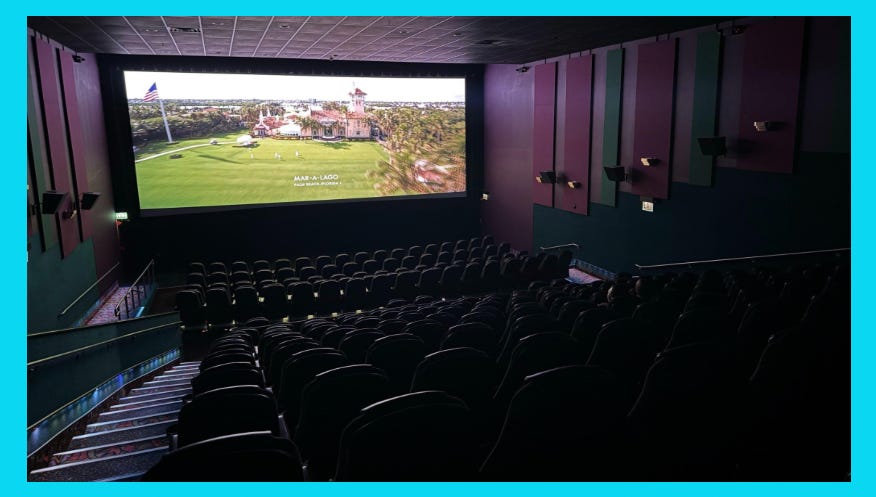
On a frigid Chicago January evening, I make my way through a bustling multiplex, to a near-empty theater occupied by just one other couple. I’m realizing we’re getting our own private screening for the documentary Melania on opening weekend.
This is not a normal movie review, since I’m here on assignment for Unfortunately Not a Sound Bath—it’s a messaging autopsy. UNASB’s goal is to get out of our bubble, study the content millions of people are consuming, notice the patterns, and translate those patterns into better real-world conversations.
Amazon reportedly spent around $75 million for the story and distribution rights. The price tag had critics calling it a “propaganda piece” and “open bribe” under the label of a biopic. The film centers around Melania Trump’s experience as First Lady-elect during the 20 days leading up to the 2024 Presidential Inauguration. To be fair, this may have been an interesting story in other hands instead of the Epstein connected director, Brett Ratner.
When Vibes Replace Substance
As Monica Hesse observed in The Washington Post, there’s nothing to see here—and hiding Melania’s true personality “is, in fact, her personality.” This isn’t a flaw in the documentary, it’s working exactly as intended. The absence is the point, emptiness is the brand. The film’s vibes just require production value to persuade viewers with atmosphere and aesthetics.
The film sells us the image of Melania Trump following a formula of three repeating pillars —Family, Business, and Philanthropy. In many positive promotions for the film, these themes were incanted constantly. Say it enough times with the right music and lighting, and maybe no one will notice a lack of evidence of these things.
The Family That Never Connects
Let’s start with Family. The film mentions it constantly. We see Melania Trump lighting a candle for her deceased mother, a brief shot of Barron Trump, references to Donald Trump. But watch closely—there’s no actual connection shown. No conversations, no warmth, no moments that reveal relationships. Melania is surrounded by staff in every scene, moving through palatial spaces alone. In her gilded palaces, I’d almost feel sorry for her. The out-of-touch comparisons to Marie Antoinette are not new, but at least Marie had her cosplay Hameau de la Reine to pretend she connected with the working class.
This is a film about a family that rarely appears in the same frame with anything resembling intimacy. It’s the aesthetic of family—the word invoked, the symbolic gesture—without the substance. Even the moments that should feel intimate are staged for maximum emotional manipulation. The private moments in a cleared out church for Melania’s candle-lighting scene, or the “unifier” line from Trump’s inauguration speech, highlighted in the trailer and edited to appear as if he nods acknowledgment to Melania’s earlier scene contribution. (Rewatching the speech, the acknowledgement never happened.)
Some critics have tried to paint Melania as a trapped Rapunzel, a victim waiting to be saved. Maureen Dowd got it right in The New York Times: she’s not imprisoned in the tower, she’s “comfortable in the frosty vertical solitude,” swaddled in luxury. The isolation isn’t inflicted on her—it’s cultivated.
The Business Empire That Isn’t
Then there’s Business, the second pillar. Her empire, as promoted in the film and press materials, consists of: a cryptocurrency venture (launched shortly before the crypto market crashed), NFTs (that barely sold), some jewelry, and holiday ornaments. There’s also a publishing company with one product—her own coffee table memoir and this film deal. That’s it. That’s the business portfolio of someone positioning herself as a serious executive.
As critics at The Atlantic have suggested, the film is really a “hard launch of a new lifestyle brand.“ They’re right. This is an extended infomercial for Melania the brand—the memoir, the jewelry, the crypto ventures, the aesthetic. The film itself IS the business, which explains why the actual business empire feels so hollow. She’s not building businesses; she’s licensing her image. The product is the mystique.
Compare that to the hours of footage devoted to showing us luxury, wealth, and designer consultations. We’re meant to absorb “successful businesswoman” through atmosphere, not evidence. The film lingers on a video call with France’s First Lady, Brigitte Macron, featuring an impossibly long shot of a MacBook—ever so naturally perched on Melania’s memoir. Everything is product placement, including Melania herself. We’re watching a commercial disguised as access, branding disguised as intimacy.
In promotional interviews, her agent, Marc Beckman, described the film as a “fashion explosion” showing “how she gets dressed, how she selects her styles.” In promoting a documentary about a First Lady’s work, the selling point is wardrobe selection? My mistake, Marc, I thought this was about a successful immigrant executive businesswoman rising to the top.
The Philanthropy Platform
And then there’s Philanthropy, the third pillar. The film leans heavily on “Be Best,” her anti-cyberbullying platform. What it doesn’t mention: the platform has been functionally dormant for years, with minimal activity on her website or social media about it since the end of her first term. The irony—that her husband remains one of the most prolifically vitriolic social media users in history—goes entirely unaddressed.
In promotional interviews, her agent lists examples of the First Lady’s accomplishments: the Take It Down Act, foster care executive orders, AI initiatives for children. But notice what’s missing: implementation details, measurable outcomes, follow-through.
The “Fostering the Future Together” program is announced with universities “involved,” but where are the students? How many have been helped? The one anecdotal letter he mentions—from a teacher who benefited years ago—is telling. If this were an active, robust program, there would be hundreds of stories, not one carefully-curated testimonial.
There was also a “Unity” purse partnership with Gucci, where 20% of proceeds would supposedly go to charity. You’ll just need to drop $2,800 on your next shopping trip to Beverly Hills. Which raises the question, who’s benefiting? The film wants you to absorb “philanthropist” the way you might absorb “glamorous” or “poised”—through repetition and aesthetics, not through demonstration.
Her agent claims she works “seven days a week from 6am to past midnight. Every day. There’s never a vacation day.” If true, where’s the output? What are the receipts for all those hours? The film itself—covering 20 days—shows us designer consultations and party planning. That’s what “working around the clock” looks like in this universe: curating the appearance of work, not the work itself.
Who This Film Is Really For?
Who watches this and comes away satisfied?
Sitting in that near-empty theater (that seats 300), I desperately wanted to ask the only two other people why they were there. Were they Melania fans? Hate-watchers? Critics? Unfortunately, when the lights came up, I must have blacked out since the next thing I knew I was standing outside, brought back to reality by the frigid Chicago evening. My numb brain needed a strong drink.
Later, as I decompressed and pored over my notes, I went looking for any authentic positive response without direct ties to Jeff Bezos or the Trumps. Just like in the film itself, it took a lot of searching to find anyone praising her who wasn’t getting paid, one way or another.
To better understand the target audience, I attempted to break down who was buying tickets to see the film.
The Trump loyalists tended to be older women in sold-out theaters in wealthy conservative strongholds like Florida and Texas. They describe Melania as “beautiful, classy, poised” and most importantly, “an influence to Trump.” For them, the three pillars don’t need evidence—they’re articles of faith. The film confirms what they already believe about proximity to power equaling virtue. These are fans of the Trump brand regardless of what shape it comes in, and Melania has always been the most palatable package.
The apolitical parasocial viewers who might be the ones that secretly peek in their party host’s medicine cabinet. Their investment is to happily watch the drama unfold like a reality show, ambivalent to the real-world consequences. They don’t care if the business is real or the philanthropy is active—they’re here for the aesthetic of wealth. The three pillars are just set dressing for voyeurism.
The Alchemy of Propaganda
This is the danger of the modern influencer class: making billionaire excess feel not just acceptable, but deserved and achievable. Melania Trump floats from scene to scene, moving between private jets, designer clothes fittings, glitzy residences, and golden eggs, with language about “hard work.” It’s telling non-political viewers that this level of wealth isn’t about inheritance or corruption—it’s about work ethic.
That is if they just worked “seven days a week,” they too could have designers consulting on their wardrobe choices. It’s the American Dream repackaged as the American Royal Family, and you’re invited to watch but can never actually touch.
The Protection Racket
Here’s what keeps me up at night: the film works even when it doesn’t.
Sophie Gilbert in The Atlantic put it bluntly: “Melania the movie isn’t a documentary; it’s a protection racket.” Amazon—which has extensive federal contracts through AWS and whose CEO Jeff Bezos owns the Washington Post and Blue Origin—paid $40 million for this film with $28 million going directly to the Trump family coffers, far above any competing bid, adding $35 million for marketing. Amazon reps insisted they invested so heavily because they “think customers are going to love it.”
The film made $7 million in its opening weekend—technically “the strongest opening for a documentary in a decade.” But as Sam Adams noted in Slate, there’s an old Hollywood term for a $75 million movie that opens with $7 million: a flop.
But that was never really the point, was it? Bezos dined with Trump at Mar-a-Lago just weeks before this deal was announced. Days after the film’s release, Defense Secretary Pete Hegseth visited Bezos’s facilities. The film premiered at the Kennedy Center—not with celebrities, not with Hollywood, but with government officials. Government officials attending a film about a First Lady, distributed by a company that needs those officials’ approval for federal contracts.
This isn’t just a bad movie. It’s a transaction dressed up as art. And while Amazon spent $75 million on this vanity project, they laid off one-third of Washington Post staff, including investigative reporters who might have covered the transactional nature of that very deal.
If you’re wondering what a “protection racket” looks like in practice, that’s it. The corruption isn’t hidden—it’s performed as culture, with a red carpet.
The New Blueprint
It’s what critic Sonny Bunch in The Bulwark calls “a pure and naked instrument of grift and propaganda deployed to great effect on an audience happy to lap it up.” Theaters in Florida and Texas sold out with people paying to bask in the golden glow of Trump Tower, even as my Chicago theater sat empty.
Trump supporters bought validation and millions more will stream it, absorbing the message that wealth equals virtue, that emptiness equals mystery, that a life of fittings and place settings is something to aspire to rather than mourn.
This is the blueprint now. Not to convince people with arguments, but to train them to accept branding as reality. To consume power as entertainment. To mistake production value for substance. To scroll through life absorbing vibes.
So, I’ll ask anyone with the misfortune of seeing this film (and the couple in my screening), is this what legitimacy looks like? Does wealth equal virtue? Does access equal truth?
But we’re not helpless. We can refuse to stream it. We can spend fewer dollars with Amazon, the company run by a billionaire that gifted $28 million to another billionaire while laying off a third of their Washington Post journalists. We can patronize actual documentaries that investigate power instead of performing it.
More urgently, we need to recognize propaganda when we see it. Not for us to become paranoid, but to become literate. To notice when editing fabricates truth. To question when we are told to stare at golden shiny things and ignore reality.
Because if we can’t tell the difference between what is and what was, we’ll already have lost more than we know.

Love your post and this re-cap rings so true. Melania is a fabrication, and absolutely we need to see the extent of this damaging propaganda. Thank you for this!