

We Have to Think in Terms of Addition
A guide to the six personas the Right is winning — and how the Left can, too.

Last month I wrote about the diverse visions of identity the MAGA movement trades in: TradWife and the Dissident Right, being two cultural concepts that seem to occupy opposite ends of the right wing spectrum on aesthetic and culture but reflect a similar type of image: a heroic alternative to a lonely reality. My piece put forth that the Right’s most powerful tool isn’t policy or outrage—it’s identity. A story about who you will become when you join.
My DM’s about this piece had some version of the same question: are these people actually reachable?
My answer, having spent months inside the right-wing media ecosystem as a part of Unfortunately Not A Sound Bath (UNASB), is YES! Our movement is losing support that should be foundational. These folks aren’t fringe defectors, they are ordinary folks in real pain who reached two doorways and walked through the one that welcomed them.
It used to be that the ‘door’ to our political movement was a tent flap that was held wide open to welcome everyone. That has changed. What happened to being a ragtag group?
We, the left, haven’t been as open as the right. We’ve been self-righteous and sometimes smug about being accessible.
I’m looking at you, my friend who turns up your nose at TikTok influencers, but are happy to share your insights in longform essays.
I’m looking at my colleagues who don’t want to see their stuff cut up into clips for YouTubeShorts even though it’s what could get us a foothold into wider audiences. I’m looking at those of you who look for offense before someone who “looks the part” has even said a word to earn a rebuke.
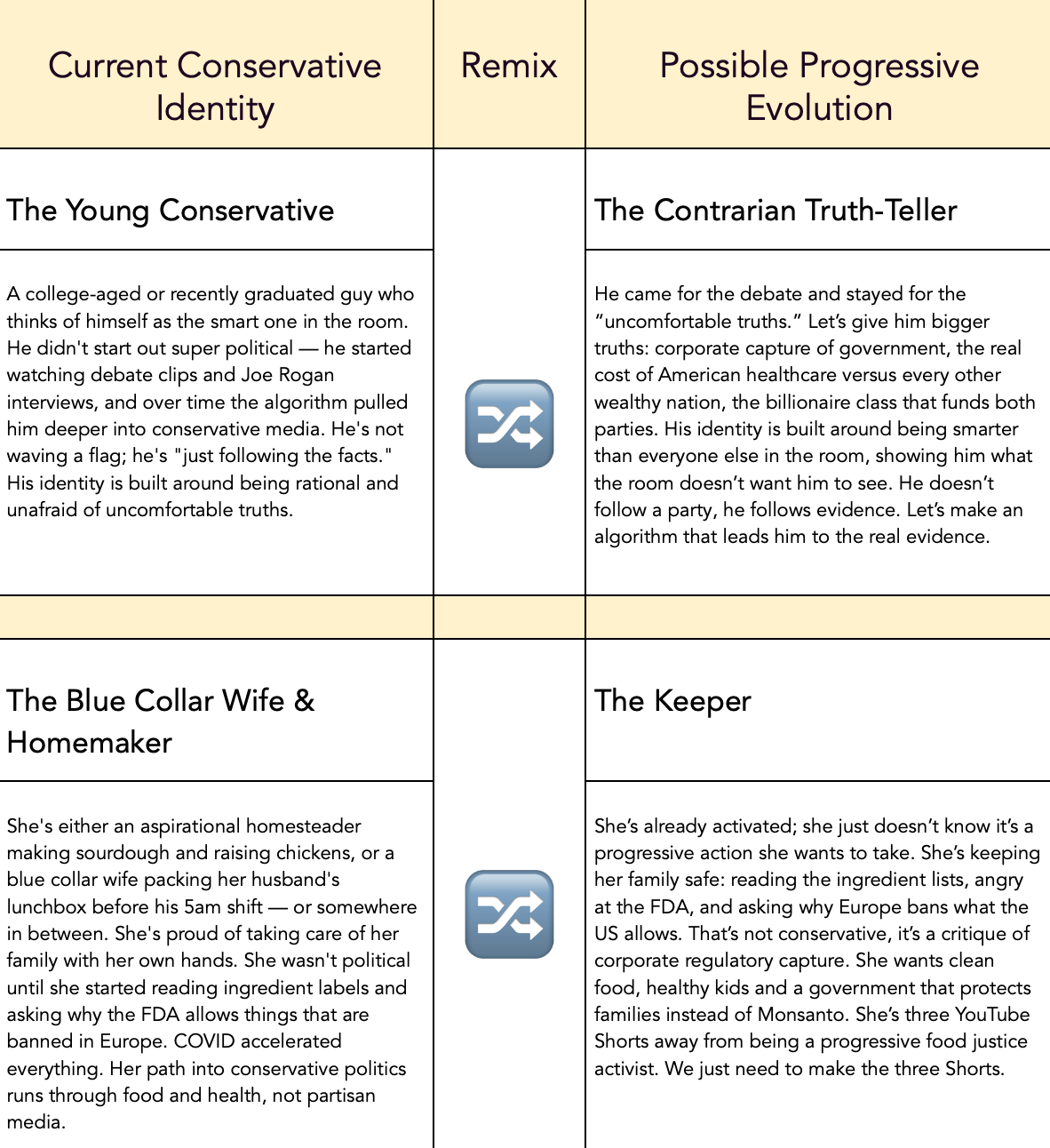
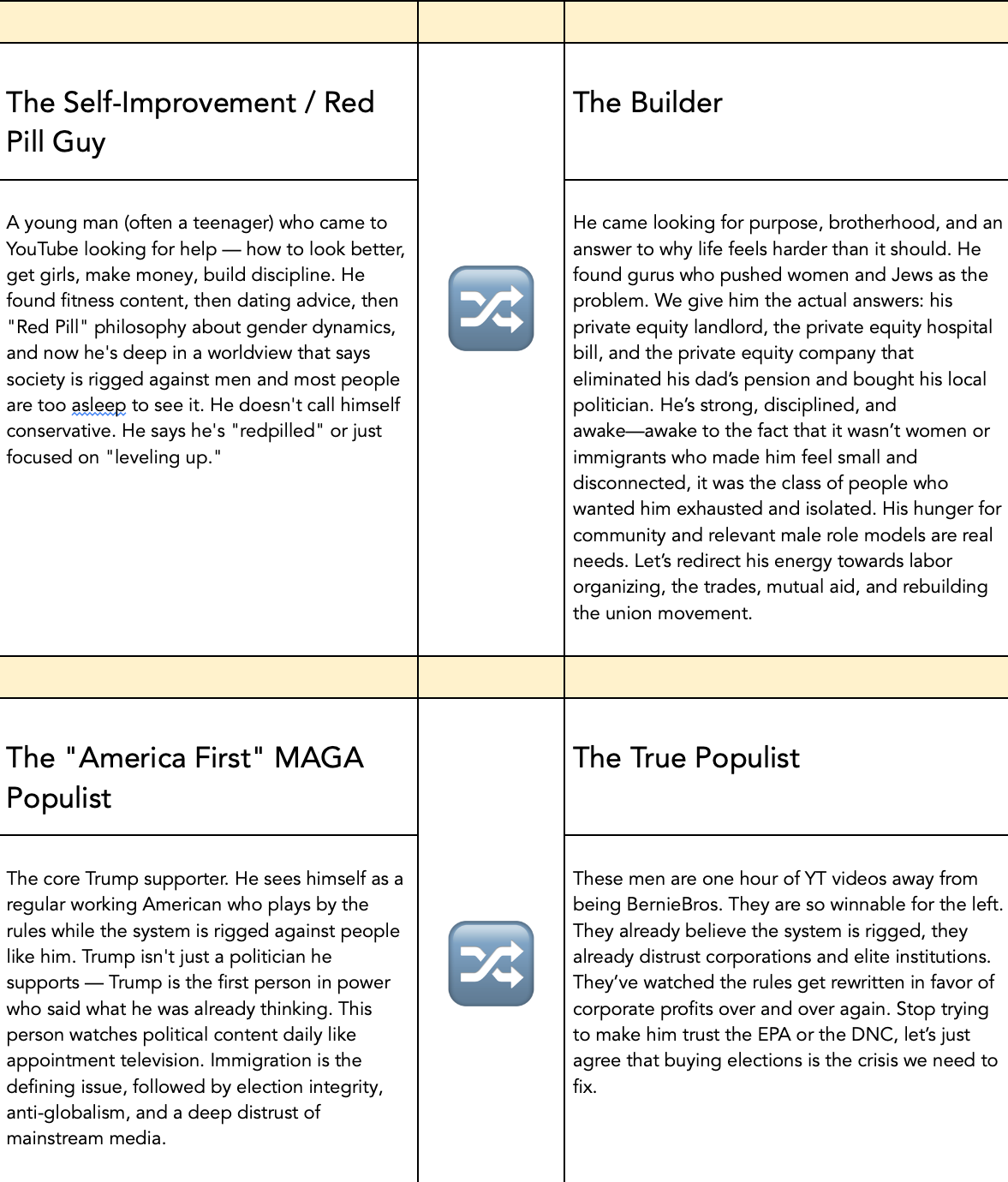
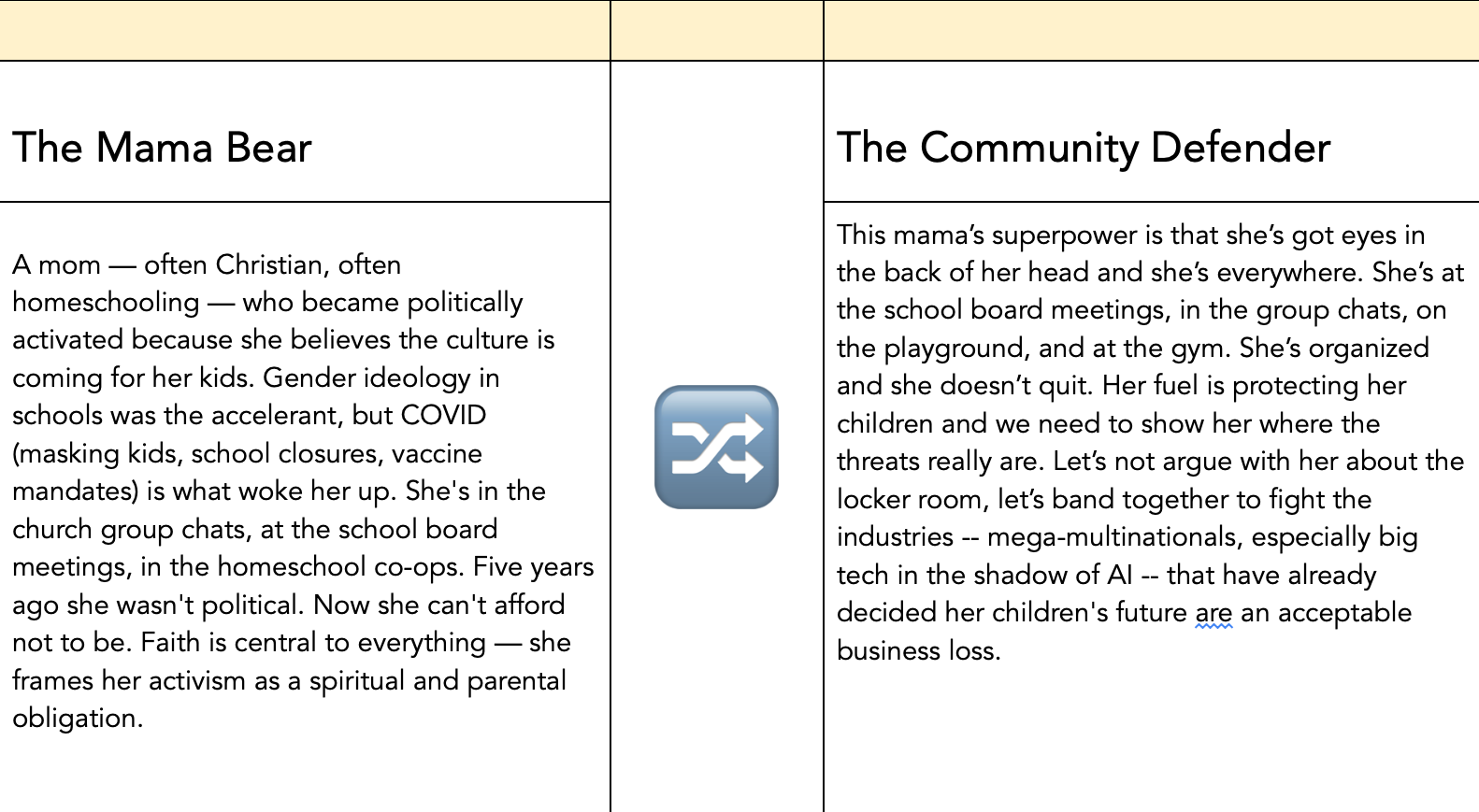
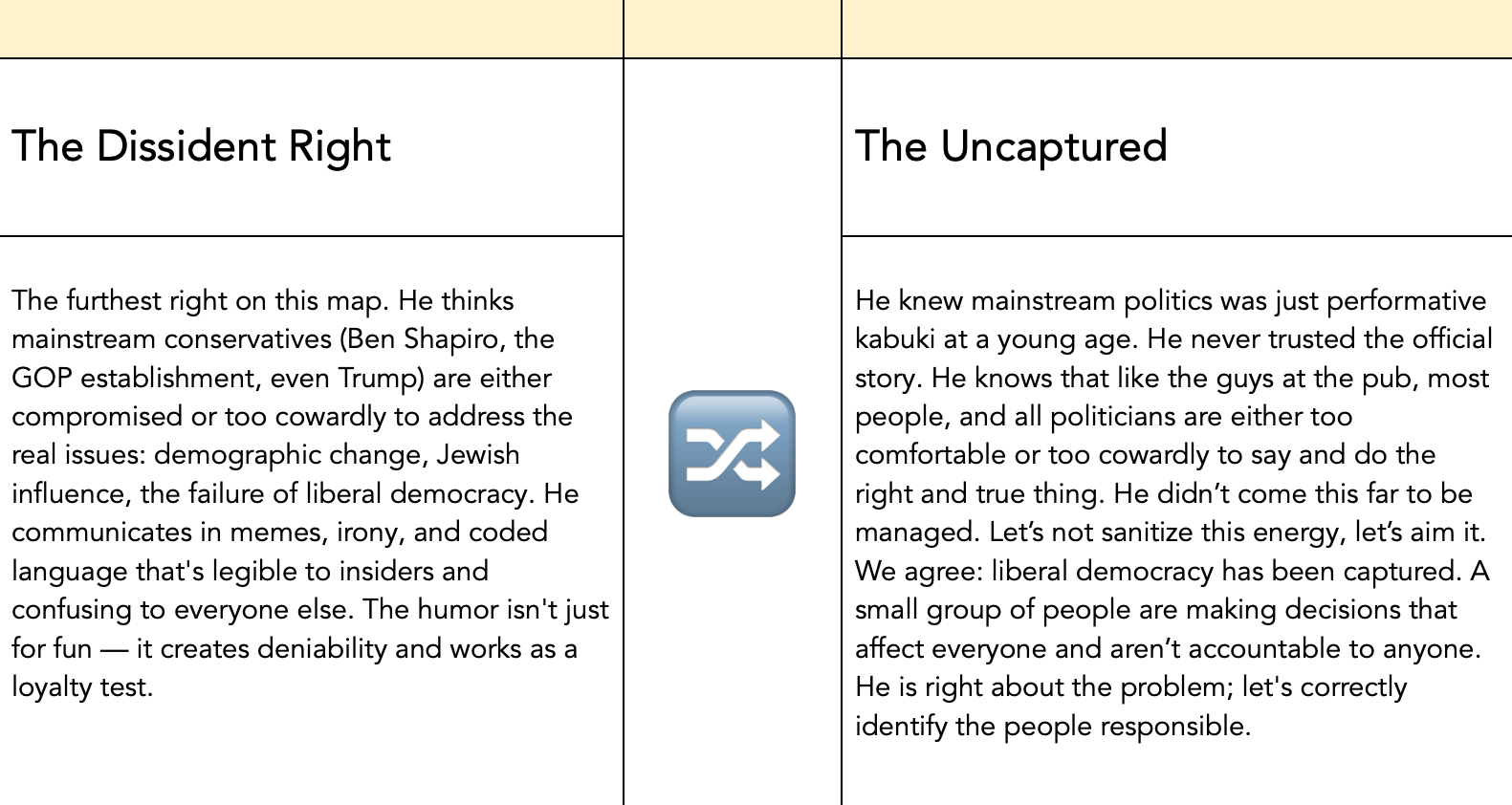
UNASB members are researching the behaviors of six distinct right-wing personas this quarter — six different entry points into conservative media, six different wounds, six different promises made and kept just barely well enough to hold their coalition together, for now. Sitting with all of them, persona by persona, I don’t see a wall. I see doors we’ve been locking closed – either because of our smugness, because having persuasive conversations feels too difficult, or because, quite frankly, summoning good manners and civility towards someone who clearly has no respect for you or openly disapproves of who you are, is flatly difficult at the best of times.
Except it is costing us. At the ballot box, in legislation, in policy, everywhere.
At some point, if it’s endlessly costing you, even among persuadable voters, that’s a call to look hard in the mirror.
At the Skoll World Forum last spring, Rachel Kleinfeld — one of the country’s leading researchers on polarization and democracy — said something that I haven’t been able to stop thinking about:
“There will always be a hard core that will never agree with us, but there may be many others who look or vote differently and will agree with us — if we let them save face, if we let them move around a polarizing issue rather than insist that they come directly to our side.
Pluralists make room for such half-agreements, for give and take. Because we think in terms of addition, not subtraction. If we want positive change and we live in a diverse world, we just can’t shrink the coalition of people who could be on our side in important fights.”
Rachel Klienfeld Clip:

I’ve crafted identities and messaging that could be persuadable to these groups. I want to hold Kleinfeld’s frame as we look at these six personas and their alternatives.
My question isn’t how we win the argument, but how we leave the door open.
Enjoying this read? Share with your friends!!!
Our political challenge is like any hard relationship where someone has said or done something that put real distance between you, and you’re faced with the choice of how to move forward from a wound. Advancing together doesn’t require forgetting. It doesn’t require pretending the hurt wasn’t real or significant.
It requires deciding that what you could build together is worth more than the satisfaction of being owed an apology.
That is what magnanimity actually means — not letting people off the hook, but refusing to let the hook become the end of the story.
The Right has been telling half of America that they are the forgotten ones, the wronged ones, the ones the system was built to exclude. Some of these folks are genuinely unreachable. But based on how things are going, a lot of them are probably looking for a new door to open in the midterms. Now we have to be big enough to hold it open.
 | A guest post by
|