

The Increasingly Blurry Line Between Influencers and Reporters
Why right-wing stars parrot journalists and what it means for real reporters in pursuit of the truth

Snaking a drain doesn’t make someone a plumber. Changing a lightbulb doesn’t make them an electrician. And filling a tank of gas doesn’t make them a mechanic.
In the same vein, writing a paragraph, recording a video, and speaking in the rolling lilt of a newscaster’s voice doesn’t make someone a journalist.
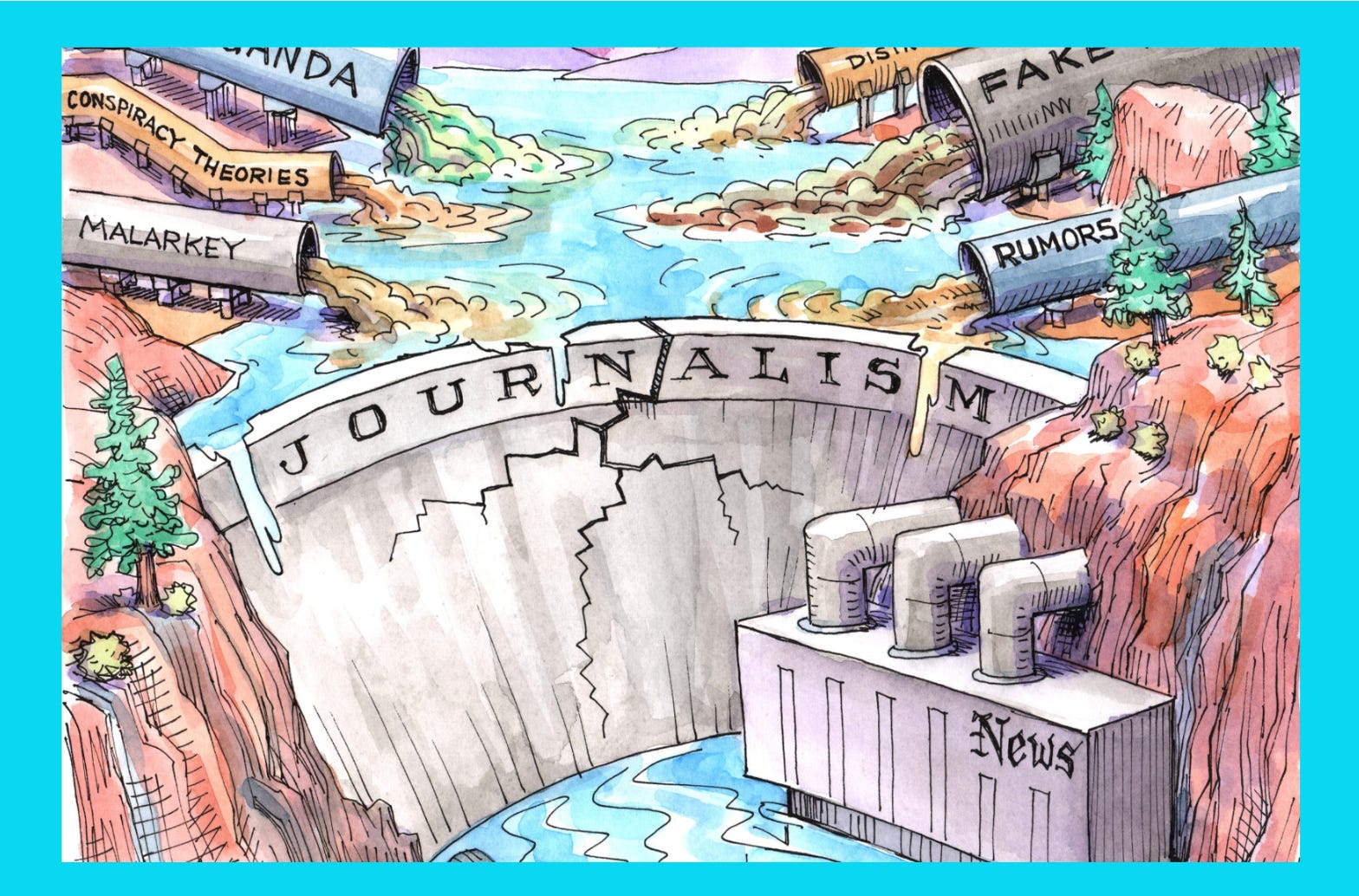
Journalism is a trade. It is a set of learned skills bound by ethics, norms, and decades of case law. It is the pursuit of truth, and at its best, it ‘comforts the afflicted and afflicts the comfortable.’ But today, the journalism industry is far from its best. It is a deeply flawed tradition that hasn’t always upheld its call to publish the truth and has a long history of entrenched bias. It is also still several steps behind the information ecosystem of the internet, which, as a tool of democratization, drastically changed the way people value and understand journalism. Today’s internet is riddled with the now broken URLs of once vaunted outlets, and the years-long period of media layoffs has transitioned from the clap of a cramp to the debilitating familiarity of chronic pain. And, most discouraging of all, an industry that relies on trust above all else has become a villain across the political spectrum.
And yet, as traditional outlets spin into oblivion due to their own poor decisions, relentless corporate consolidation, and political attacks, the trappings of journalism remain exceptionally powerful.
As a member of UNASB, I’ve seen over and over how right-wing media leverages the tropes and terminology of traditional journalism to gain credibility while also undermining establishment media at every turn.
Within minutes on a podcast like the Michael Knowles Show, you’ll hear the host state that he doesn’t believe the mainstream media and then play a CBS news clip as evidence of his claims. Meanwhile, Calley Means, a senior advisor to the Department of Health and Human Services, regularly undercuts the scientific consensus reported in major outlets, but as a guest on Alex Clark’s podcast, he is proud to boast that his book is a New York Times best seller. And these podcasters, despite their ire for “the media,” nevertheless emulate much of the same affectation you hear in traditional news journalism: the placeless accent and shifting pitch designed to keep the audience engaged and convey a level of serious authority.
And then there’s the investigative reporter cosplay. In his viral video “exposing” a ring of fraudulent childcare providers in Minnesota, Nick Shirley positions himself as the only independent reporter brave enough to face and share the truth. In the serious tones of an evening news anchor, he claims that daycares are taking public funding without actually enrolling any children. He then proceeds to ambush several facilities and demand to see proof of kids in their care. The daycares’ refusal to allow unknown adult men to lay eyes on children is used as evidence of their wrongdoing, rather than an appropriate protective response. Shirley also fails to properly identify himself as a reporter to the childcare workers he interviews and instead pretends he’s a potential customer to bait them; being honest about who you are is journalism 101. By definition, people like Nick Shirley are not journalists. They are not operating within the ethical or legal frameworks of journalism and are instead misleading their audience to score political points.
Traditional media brands are anathema to them and their anti-establishment audience, but they understand that parroting reporters is a fast pass to credibility.
This content works in part because it’s salacious. There’s a crass journalism adage that “if it bleeds, it leads,” and the right has a penchant for turning scabs into gaping wounds. It also reinforces the audience’s existing opinions and provides “evidence” for beliefs rooted in hatred. It feels good as an audience member to be told that you’re right. And this material effectively targets people who may otherwise be unmoved by conspiratorial thinking. The content seems more reasonable and persuasive because its journalistic constructs feel familiar, even if belief in actual journalism is cratering.
And therein lies hope.
If institutional media trappings are still valuable, then the real journalists have a shot to win the day. Influencers play a valuable, but distinct, role in political communications; they can explain, contextualize, or repeat factual information to spread awareness and amplify a message. People without a traditional news background have done powerful reporting on their own, including influencers such as Arielle Fodor (known as ‘Mrs. Frazzled’ on social media) and Cheyenne Hunt, whose work helped journalists break the story about Eric Swalwell’s history of sexual harassment and end his gubernatorial campaign. The influencers, who are not bound by the rules of newsrooms but do have significant trust from their audiences, posted allegations against Swalwell and then passed material to institutions with fact checking resources to put the full story together. This dynamic should be used as a playbook for news outlets. In certain circumstances, reporters should do their best to substantiate well-intended influencers’ claims, because those same influencers can, if proven correct, maximize the reach and resonance of reported facts.
Journalists can also learn from influencers by diversifying the platforms they use to reach audiences.
Today, reporters with traditional news backgrounds who have left legacy media are branching out onto platforms like Substack, some as a matter of post-layoff survival and others as an attempt to proactively seek the middle of the Venn diagram between journalist and influencer. Reporters in this position occasionally brandish their establishment media credentials to build an audience and cultivate trust and authority, despite lacking the editorial apparatus to fact check their copy or protect them if someone decides to sue.
To break through the cluttered attention economy, independent journalists stand to benefit from distancing themselves from the baggage of establishment media but not the processes, visuals, or standards.
They have the opportunity to produce reliable, fact-based content on their own platforms with contracted editors and, if needed, legal support behind the scenes.
Just as influencers are piggy-backing off journalists’ tried and true tricks, independent journalists can leverage the tropes of influencing to advance the truth. They need less polish, more personality, and more humility. Many of the right-wing “exposès” that are most effective are framed as regular people asking questions, leaning into what they purport not to know, and feigning outrage at the answers they’re hearing. Journalists shouldn’t play dumb to manipulate their audience, but they can take their readers and viewers along as they learn something new and react to that information organically. Allowing the audience to see behind the scenes generates buy in and creates a deeper sense of connection between the reporter and the viewer. Establishment outlets can do this, too, by increasing reporter engagement with well-intentioned comments, which the New York Times does, and allowing individual reporters to flash more of their personality in their work.
If truth really is stranger than fiction, then reporters can run laps around people brandishing falsehoods for clicks by being honest. Journalists must internalize that being truthful and being captivating are not mutually exclusive.
The United States is facing a crisis of shared truth. This is a difficult problem to reverse but cannot be accepted as intractable. Accurate reporting that is engaging enough to reverberate online is an essential piece of the solution.
 | A guest post by
|
I love this so much! Being a child of the sixties and growing up with traditional journalism, it has been so frustrating and scary for me to watch it's demise. I have struggled to think of a way out of the information mess that unbridled social media content has caused. Happily, I think you have nailed it!