

My Takeaways From the Past Seven Months of UNASB
How the right-wing took over American podcasts... And where we go from here.

FWIW: A Few Short Caveats Before We Begin
Over the last seven months, I’ve been surprised (horrified) to find that many of the most popular right-wing creators/podcasters, as extreme as they are in the short clips circulated in my feed, can be compelling and even charming when given an hour to speak on their various podcasts. The commentary they offer, harmful as it is, is deceptively simple and easy to understand.
I don’t work in politics but I care deeply about our political future. I’ve watched as the right has monopolized the conversation online, and I think it’s critical that left-of-center people take a serious look at these creators and try to learn what makes them effective.
It’s worth noting that our digital news ecosystem is not a fair marketplace for ideas. A lot of powerful interests are working behind the scenes to socially engineer the information we see, keeping us ill-informed, angry and divided.
I disagree with the entire belief system, rhetoric, peddling of racism, homophobia, transphobia, and harmful conspiracy theories that right-wing content creators like Ben Shapiro, Candace Owens, and countless others have made their careers normalizing.
With all these items in mind, our political process still relies on understanding and engaging different perspectives. Ignoring the loudest and most popular voices on the right isn’t just bad politics; it makes it impossible to understand the information people are consuming on a daily basis. The cues that these creators have perfected to reach millions of partisan and politically ambivalent listeners are not captured in the short clips amplified on TikTok and reels. We ignore these cues at our own risk.
The Podcast Election
In 2025, over 210 million Americans listened to podcasts. 55% of listeners identified themselves as weekly listeners. There is no longer any doubt that podcasts are a primary source of news for the vast majority of Americans.
One of the reasons I value UNASB is because I’m interested in how the Right has cultivated and expanded an online ecosystem of podcasts and creators.
As part of the 2024 campaign, President Trump and Vice President Harris appeared on dozens of podcasts in the four months leading up to the November election. “20% of likely voters… [said] they have watched one of the Trump podcast episodes… More than half of [listeners] said Trump’s podcast interviews made them “more likely” or made “no difference” on their decision. In contrast, about 27% of voters said they have watched one of Harris’ appearances on podcasts. But for those who… watched, about 50%… said it made them less likely to vote for her.”
Not only did President Trump make more appearances, but the appearances he made persuaded more voters to support him.
While Harris did make campaign stops on Call Her Daddy, The Breakfast Club, and The Howard Stern Show, her appearances focused primarily on the election and her candidacy. Meanwhile, Trump talked about professional wrestling with Mark Calway, spent three hours on a live show with Joe Rogan and joked with Theo Von on This Past Weekend. Overall, President Trump visited more non-political shows and took more risks to build his audience.
What I want to stress here is that the right-wing’s dominance of podcasts and emerging platforms didn’t happen in a vacuum. The right-wing has systematically developed an ecosystem of commentators and creators over the last decade. Media Matters identified nine of the top ten of the nation’s largest podcasts as “right-leaning.” Of the 320 shows the organization analyzed, approximately 60 percent met the same “right-leaning criteria.”
This piece is my attempt to outline some of the things I’ve learned as part of UNASB, reconcile with this reality, consider ways the left could break through to new audiences, and take on this right wing media ecosystem.
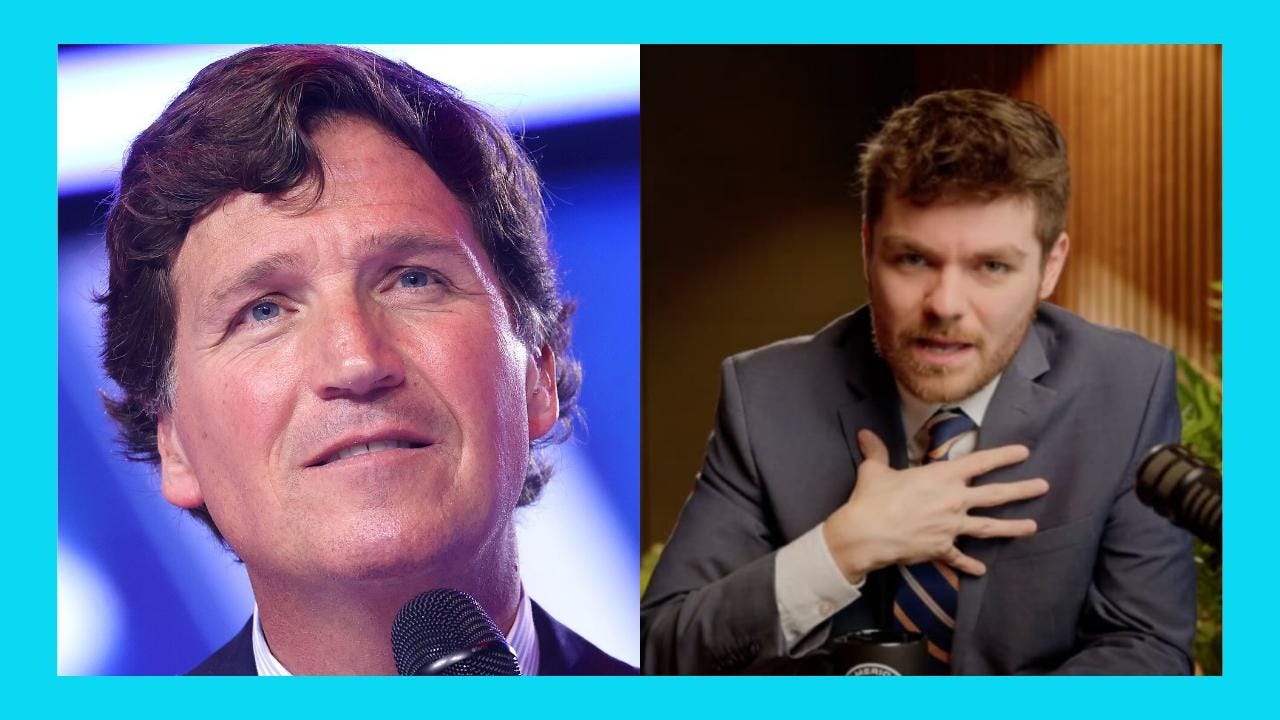
Case Study: Will The Real Tucker Carlson Please Stand Up?
The first thing I noticed when listening to and watching Tucker Carlson’s podcast, The Tucker Carlson Show, was his tone shift compared to his evening show on Fox News.
On TV, he could be found most weeknights sporting a bow tie and floating conspiracy theories like whether President Obama had wiretapped President Trump. The Fox News version of Tucker Carlson was combative, hyper-partisan and a lot more aligned with the GOP establishment.
Podcast Tucker is different. He’s more laid back. He wears flannels, makes jokes and presents himself as a reformed zealot seeking common ground. Whether this is true or not, this is the way podcast Tucker presents himself.
During Tucker’s conversation with Ana Kasparian, host of The Young Turks, the two talked like old friends. They laughed together and found common ground on a range of issues, like Israel, the homelessness crisis—while still allowing for deep differences. This conversation employed one tactic that I’ve seen across many right-wing podcasts: the “agree to disagree” maneuvering. There are many issues on which Tucker Carlson and Ana Kasparian disagree: whether the 2020 election was stolen, whether women should have a right to choose, etc. There were moments where each person came close to discussing these topics, but, frustratingly for me as a liberal listener, they completely dodged them. By maintaining this agree-to-disagree compromise throughout, the conversation was cordial and created room for them to find issues they could agree on: like the genocide in Gaza, the need for better services for people experiencing homelessness and ways that big companies push agendas on the mainstream news channels.
This is no small feat in today’s political climate and it’s a deliberate strategy to maintain civility and conceal the real differences between the left and the right. It’s replicated across new episodes every week. By actively avoiding the most bombastic disagreements, welcoming guests with radically different political views and maintaining a friendly banter, Tucker Carlson has strategically reinvented himself, enabling him to reach new audiences and mainstream the views of some of the country’s most radical right-wingers.
Case Study: Nick Fuentes Can (And Will) Say Anything
Growing up, Nick Fuentes listened to the popular right-wing radio host Mark Levin every day. Levin is a radio personality best known for accusing President Obama of being linked to the Muslim Brotherhood and peddling the great replacement theory. The right-wing radio show host has an innate ability to boil every issue, no matter how complex, down to a simple left versus right and right versus wrong framework. As a high schooler, Levin’s simple, pro-America rhetoric resonated with Fuentes.
Fuentes’ early podcast episodes reflect a more boilerplate version of traditional conservative rhetoric; over the last decade his tone and content have grown much more fringe.
After listening to a few of his episodes, I would characterize his approach to podcasting as a sort of stream of consciousness, angry screed attacking any and everyone. His episodes feel organically disorganized, jumping from topic to topic and shifting back and forth from blatant racism to attacks on his perceived allies to the political right. He frequently reminds the audience, “you may disagree with me, but I’m telling you the truth.”
To reiterate, I’m disgusted and appalled by almost every argument he makes and every position he supports. But… They’re not complicated and I understand them.
In the same way that Donald Trump’s early 2015 political rallies wrapped the national media for their outlandish and unpredictable quality, Fuentes has grabbed the national media with his penchant for a bizarre sound bite, his shameless embrace of racist conspiracy theories and his ability to attack both political parties. Whether you’re watching Fuentes for the first time or you’re an active weekly listener, you never know what he’s going to say—and that may be a part of the appeal.
In the episode UNASB listened to, Fuentes rambled about President Trump’s military parade. He called the parade “lame,” accused President Trump of being a “grifter,” urged conservatives to move further right and declared MAGA dead. He simplified the president’s lackluster parade to a simple and effective attack on MAGA as a whole.
Over eight years, Fuentes has recorded hundreds of hours of content and grown his following to millions of listeners. Even those of us who don’t listen to him religiously know who he is because his ideas have entered the mainstream dialogue of conservative politics.
If you need any more proof that his strategy is working, consider that the Republican Party has devolved into a full-scale revolt over whether MAGA should embrace or reject the podcaster.
Where We (Could) Go From Here
The Democratic party will never succeed if they can’t meet the moment. We are living in an era that requires a different, never-before-seen, playbook. Here are some basic and cursory things that we could do:
Identify and elevate new content creators who are platform savvy, quick on their feet and broadly likable and persuasive. One item to stress, these individuals don’t need to be expressly political. Most of the creators drawing the largest audiences are not political, but rather comedians, gamers, athletes or everyday people sharing stories about their lives.
Most people are not following politics day to day. When we talk about politics, we must focus on emotional appeals and storytelling. Specifically, we need to be better at framing the policy issues we care about in ways that resonate with people who may be learning about our positions for the first time.
Learn something from the creators on the right. Love them or hate them, they’ve quickly adapted to a new medium and simplified complex political issues for a sizable, and growing, community.
It’s not enough to call out disinformation if we’re not challenging the ecosystem that enables it to flow freely. The left must take lessons in simplistic and compelling communication from the right, to counter the content that has mainstreamed much of the MAGA agenda.
It is not enough to criticize creators we disagree with or respond to every controversial thing they say. We must make a broader pitch to their listeners, and make inroads to new audiences who are not following politics day-to-day.
Rather than disagreeing without engaging, try engaging but disagreeing.
 | A guest post by
|