


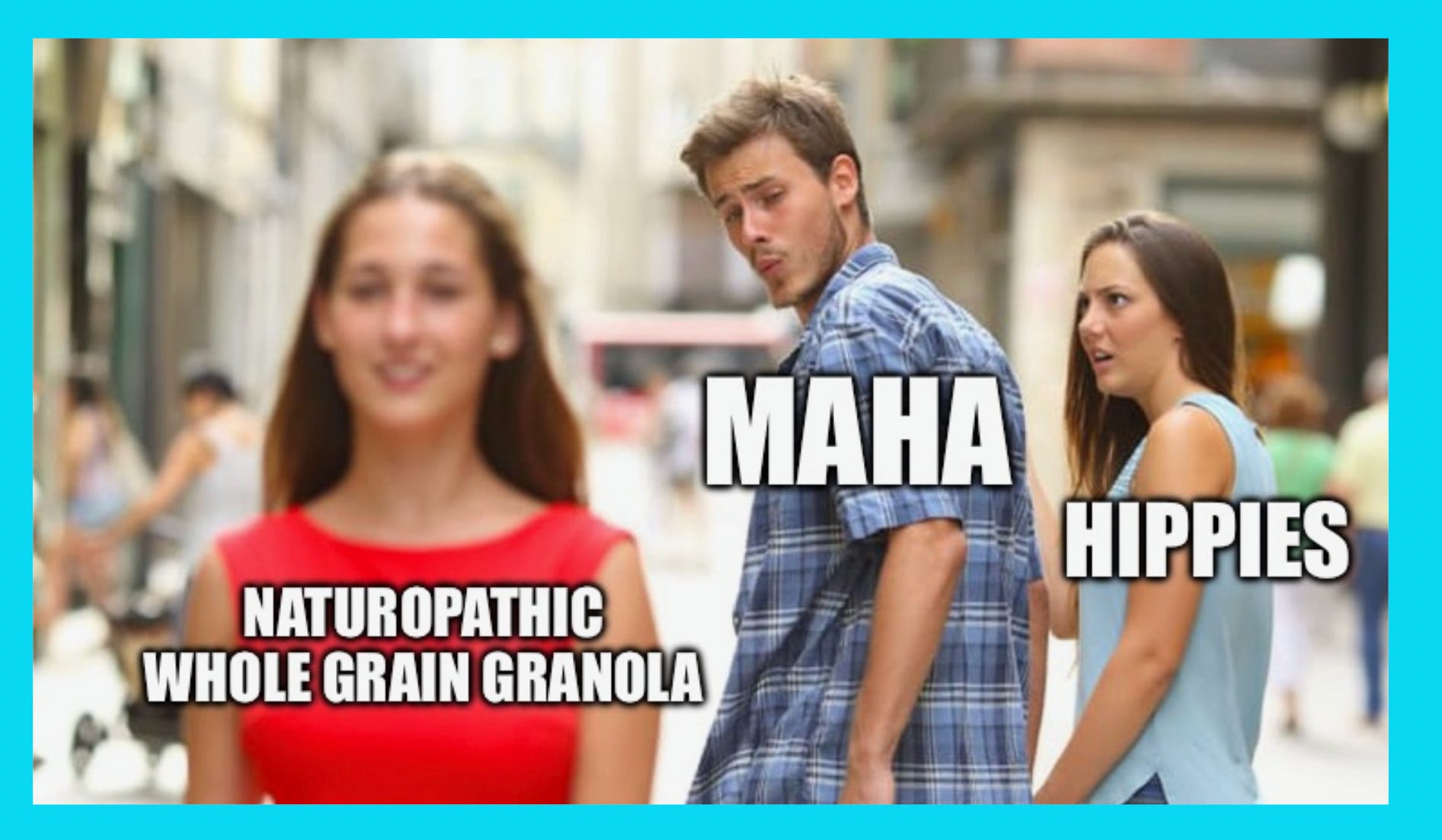
“Is MAHA just like the hippie town you grew up in?”
Since I was raised in Eugene, Oregon, a very hippie town, I get asked this a lot. I didn’t know how to answer this question until I gave Alex Clark’s Culture Apothecary a listen. Clark is a leading podcaster in the Make America Healthy Again (MAHA) movement–a key part of the MAGA coalition–with over 1.2 million followers on YouTube and Instagram. Discussing Clark’s episodes with members of Unfortunately Not a Sound Bath gave me a new window into a movement known for specific campaigns against vaccines and food dyes, but that is propelled by a network of influencers, snack and supplement companies and unelected government officials like RFK, Jr.
The answer to my friend’s question: it’s complicated. The MAHA movement has adopted and built upon many of the practices I grew up with, from eating organic food to using non-Western medicine. Yet, hippies sought to expand our options for healthy living, whereas MAHA uses political and commercial authority to narrow those options in ways that would make my hippie neighbors squirm.
Was my childhood MAHA-coded?
Growing up, my parents opted into many hippie practices. They bought tofu, yogurt and organic juice produced by local co-ops. My mom attended our community farmer’s market nearly every week and shopped organic when possible. We avoided Red 40 food dye, candy and processed food, much to my disappointment. Our neighbors were vegan. There is nothing inherently Republican about this, and yet, our lifestyle–which was normal for our community–now sounds similar to many MAHA adherents.
In my first job out of college, chronic migraines forced me to take medical leave and reduce my hours at work. I was terrified I wouldn’t be able to work again and my mom made sure I had options. In addition to visiting a headache specialty clinic, I tried acupuncture, saw a naturopath, took a mindfulness-based stress reduction class, tried biofeedback, and did an elimination diet. My neurologist wrote numerous referrals for these treatments, and ultimately, helped me choose a regimen that included a mix of Western and traditional treatments, diet changes and supplements. My mom helped cover costs when insurance didn’t, and taught me to advocate to busy doctors. It was an extreme privilege to have these options, and I wish they were more widely accessible.
When I listen to Alex Clark’s guests, like Robert F. Kennedy, Jr. advisor Calley Means and naturopathic medicine advocate Razi Berry, I’m transported back to my childhood and my struggle with migraines. Her guests speak much more powerfully to my experiences searching for solutions to mysterious ailments than any Democrat telling me about insurance subsidies. Except, there is an individualistic, commercial and emotional twist that makes me feel shame. Clark’s guests make me think that if only I tried a little harder, paid a little more money, or swallowed yet another supplement, my health would be fixed. The ads offer recommendations of beef sticks, makeup and snacks free of seed oils to complete that story in just one click. Rather than feeling like I have more options, as I did when I was sick, I worry that unless I consult people like Clark, I will inevitably make the wrong choice. My own journey reminds me that making Americans healthy will require more than individual willpower, commercial products and the right influential voice.
A wellness perspective
To talk through my feelings of familiarity and shame, I called my childhood friend Rachel Hinnen of Vorfreude Dairy Beef, who practices acupuncture and turns retired dairy cows into sustainable beef outside of Portland, Oregon. “If MAHA is evangelizing many of the hippie practices we grew up with, why do I feel so uncomfortable listening to them?” I asked.
When I called, she was quick to list the benefits of many of hippie practices now co-opted by MAHA–including grass-fed beef, non-Western medicine and even raw milk–to manage chronic illness and steward the environment. But she thinks MAHA leadership–the podcasters and politicians–are manipulative and overly simplistic.
“MAHA tells us that eliminating food dyes is the answer to our health, but that’s just more smoke and mirrors. It doesn’t matter if we remove red dye if we don’t have a system to truly support people’s health. Things like universal healthcare and food accessibility are important, long-term changes that would go a long way to offer that support,” she said.
Her farmer and acupuncture community want their experience to be incorporated, rather than marketed as a silver bullet. They are on edge waiting to see whether proposed policies to ban or replace single pesticides, ingredients or types of care, as MAHA is attempting through RFK, Jr.’s FDA, will cause more complications. Rachel helped me understand how even those who follow some MAHA practices believe the movement is using their political power to advance single solutions and oversimplify complex systems.
Expanding options for healthy living
Listening to Clark’s podcasts, talking with Rachel and following political news about MAHA helped me see how different MAHA and hippies really are. My hippie neighbors understood that the system didn’t serve everyone equally, so they opted-out of mainstream life and sought to expand options for healthy living aligned with values like environmentalism and anti-capitalism. They set up co-ops and community composting, not businesses or influencers with mass reach and revenue. Their activism focused on stopping government overreach, not using government to replace the status quo. My parents are decidedly not hippies, and yet, we were invited to participate in the community that hippies created, without shame or judgment for not fully adopting their lifestyle–a lesson the left could desperately remember.
MAHA isn’t the only option for improving American healthcare. But, the left has work to do to offer improvements.
As a narrative strategist, I’ve seen how important it is to acknowledge feelings and fears, and paint a picture of a better future. MAHA is an expert at acknowledging real concerns with our health systems, and the left could easily do that too.
Our main solution can’t mostly sound like, “Vote for us, and you’ll get your insurance subsidy back.” While valuable, those subsidies may not do enough to re-open a rural hospital, make a much-needed procedure affordable or prevent a doctor from rushing off to their next patient. What about, in addition to insurance subsidies, we work towards a future where a doctor actually has time to listen?
To be sure, some MAHA beliefs, like being anti-vaccine, are wedge issues that may be extremely difficult to overcome. But, it’s also important to remember that MAHA is an extremely broad tent. Could MAHA adherents support campaigns for healthy school lunches; bringing fresh, organic food to communities facing poverty; or working with farmers to expand organic farming?
How many MAHA adherents might actually support free, universal healthcare?
Helping Americans expand their options for healthy living to address their difficult experiences with food and health systems, is a good place to start. There may be more we can fight for rather than argue against.
 | A guest post by
|
Thank you for sharing this, Kana! Growing up in Western Massachusetts, nearly everything you describe about Eugene was eerily familiar to me. Seeing the hippie to MAHA pipeline develop has been such a challenge and a trend I'd love to see us reverse. I also have a piece coming out next Monday on MAHA. Hope both of our columns can help others!