


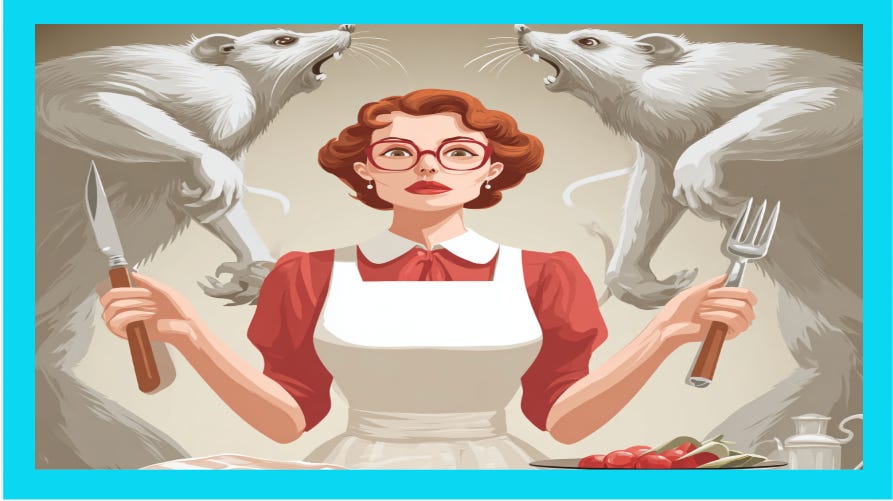
I’m old—old enough to remember G. Gordon Liddy testifying before Congress during the Watergate hearings. He said something I never forgot: he was deathly afraid of rats. To conquer that fear, he caught one, cooked it over a campfire—and ate it.
That analogy works for me and UNASB.
Before UNASB, I was intimidated by the dark-money machine—the opaque forces flowing from what I think of as the Epstein class through a right-wing media ecosystem that manufactures disinformation before there’s even demand for the truth. It doesn’t just respond to reality; it scripts it. It tells people how to think, what to think, and reinforces it until it becomes a wall.
For a long time, I didn’t want to look under that hood. It felt impenetrable—and frankly, I didn’t have the time. I chose to ignore the grotesque elements: the performative outrage, the coded racism, the bad-faith narratives fueled by money and power. I knew it was there. I just didn’t engage.
Then I found UNASB.
Within this community I was able to lower my resistance and actually listen to what the far-right is saying and doing. UNASB helped me do the uncomfortable thing: to examine it closely, understand it, and yes—if I extend the metaphor—catch, cook, and eat the rat.
We’re not just studying figures like Tucker Carlson or tracing the history of right-wing media. We’re also learning how to communicate more effectively ourselves—how to reach people, how to use the tools that successful influencers use, and how to recognize the coded language embedded in messaging.
Because that language works. It persuades people—often against their own best interests.
Take Alex Clark, who talks about wanting healthy food for her family. It’s clear that achieving that requires government support and regulation. Will she get that from this administration? Probably not.
But her brand is tied more closely to her MAHA affiliation than to the outcomes she’s advocating for—clean food, clean water, education, and infrastructure, which the non-MAHA side is pushing for in legislation.
That’s where the contradiction lives. And within those contradictions, we have opportunities—to build bridges, to connect, and to create moments of real understanding.
UNASB has given me clarity. It’s helped me understand the language, the structure, and the intent behind what we’re up against—and how to push back effectively.
Before this, I never would have spent time watching people like Benny Johnson or Ben Shapiro—paid influencers crafting narratives built on provocation and distortion. Now I can engage with that content without being overwhelmed by it.
I feel more aware. More grounded. More prepared.
And that power?
Yeah—I ate the rat. I’m not afraid of it anymore.
There’s still a lot of work to do. But UNASB has helped me see what’s out there—and what’s coming.
Bring it on.

I'm your generation — Your piece brought it back the rat consumption with a clarity I wasn't expecting.
Before UNASB, I did what you described in the early paragraphs: I understood what dark money does, what manufactured outrage is for.
UNASB changed that.. The Alex Clark example is right — that's where the persuasion happens, in the contradictions between what people say they want and what they're actually supporting. Learning to see that, and to name it without contempt, is a skill.
Here's where my story diverges from yours, though: I tried to bring my millennial sons into the next cohort. They refused. They were firm about it. They didn't want it anywhere near them.
I understand their logic. But it left me thinking: your column does something essential for those of who believe that understanding right wing media is part of fighting it. For the generation that has decided the contact itself is a problem, you're the one eating the rat ---on their behalf.
That's not a small thing. Bring it on indeed.