

How can Democrats actually “invest in digital?”
It’s time to get specific if we really want to push the left to do better online.

For years now, there have been calls for the left to “invest more in digital.” But as someone who’s spent a decade describing my own job as vaguely “doing digital politics things,” let me be the first person to say: we have to be much more specific about what we mean if we’re going to see real change in the space.
Hey y’all, this is Max Levy, your former recapper, author of The Short Answer newsletter (where this piece is also running!), and freelance digital and political strategist. I joined the Unfortunately Not a Sound Bath crew at the beginning of this year, where the discussions about the right’s cultural infrastructure and how the left can counter it have made it even more clear how urgent it is for people on our side to start doing things differently.
One place we can start is by moving from generic calls to “do better” to actually naming the changes we want to see.
Think about it. When you say “digital,” do you just mean social media? Organic social media from a candidate’s page? Running paid ads or getting other creators and influencers to post? Do you want better graphics, professional videography, smarter captions, or just higher volume? Maybe you aren’t talking social at all, and you want to see better use of email. Are you using email to fundraise? Recruit volunteers? Persuade in-state voters? Or maybe you’re thinking about something else entirely when you say “digital.” As long as you don’t mean the guy who knows how to make the projector work, you’re probably right to think of it as “digital” work. And that’s a problem for digital teams that keep getting asked to do more and more, with the same staffing and budgets.
Using “digital” as an umbrella term may have once been helpful to describe campaign (often communications) work happening online. Now though, there are so many tools, tactics, and strategies under this umbrella that just using the term leaves decision-makers with enough ambiguity to get away with not doing anything.
So, let’s run down some specific ways to “do digital better” in the political space:
Devoting budget, staffing, and time to organic social media strategy
Organic social posts (what a “typical” account creates and posts, not paid ads that bypass the algorithm entirely) are a key way that regular people engage with political accounts, but they’re often an afterthought in budgets and strategies for reaching voters or supporters. An open letter from digital strategists to party leaders details more of what it would look like to take organic social more seriously, including increased budget, dedicated capacity for content creation, and a voice in strategic decisions. For campaigns specifically, we should also ask candidates and senior-level staff to carve out more dedicated time for digital content creation and training to hone the skills and frameworks that work for organic social.
Shifting ad budgets towards digital platforms
According to Tech for Campaign’s analysis of 2024 ad spend, “commercial advertisers allocated 78% of their media budgets to digital. Political advertisers? Just 36%.”
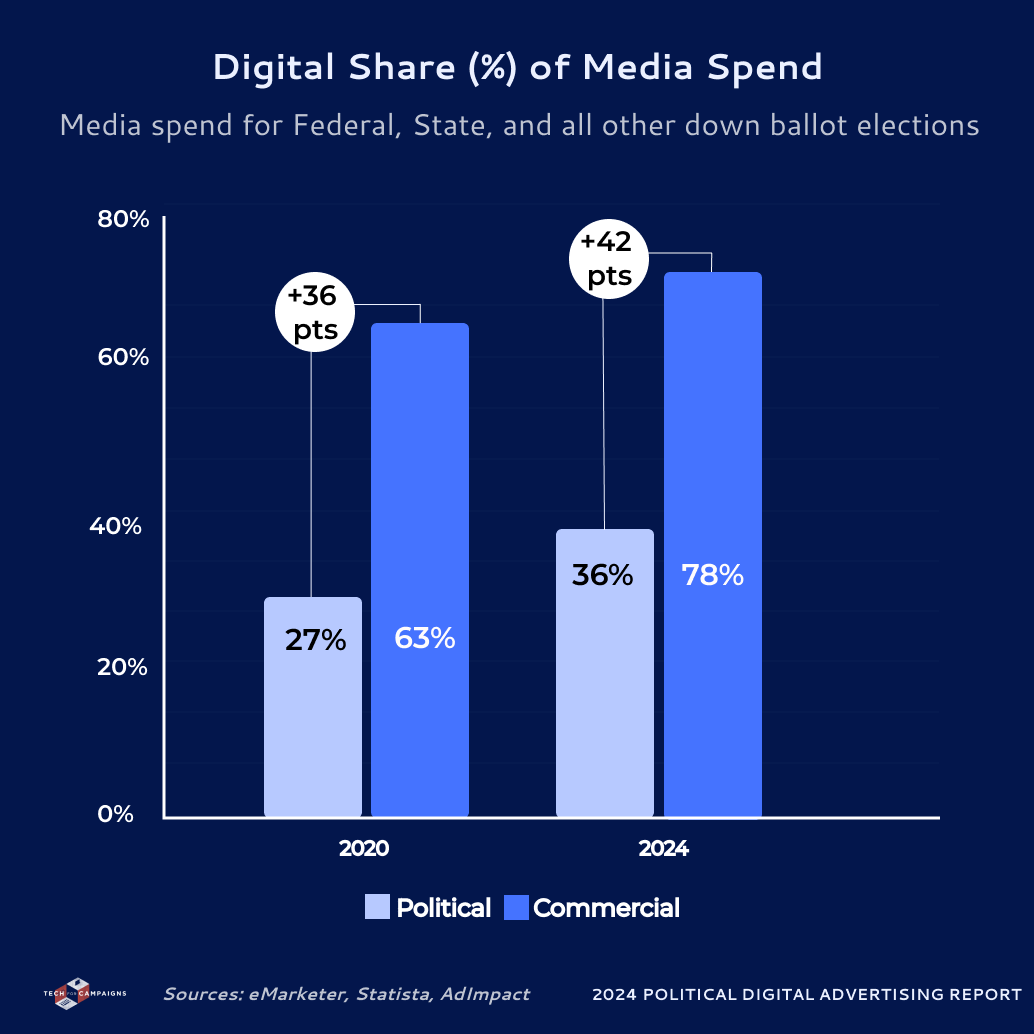
Do we really think campaigns know something that brands don’t about modern advertising best practices? Too many campaigns are still stuck in the past, and it’s time to shift to the places where people are actually paying attention. That means more budget to create digital ads, more spend to get those ads out into the world, and more latitude to test bold ideas or emerging platforms.
Building a stronger creator infrastructure — with both political and non-political creators
Races like Abigail Spanberger’s in Virginia and Mike Sherrill’s in New Jersey saw important investments in staffing, candidate time, and budget to engage social media creators in 2025, which marks an encouraging shift. But we’re still woefully behind the right in building our creator economy, and there’s a lot more time and funding that needs to be invested to get progressive ideas spreading through a self-sustaining, culturally-relevant infrastructure. (Lots more to say on this piece — stay tuned!)
Communicating better with “owned” audiences like email and text lists
Inboxes are one of the most intimate ways we communicate with voters and supporters, but too many organizations treat them as places to ask for donations and nothing else. And for smaller campaigns, they might not even have the staffing or budget to utilize or grow their opt-in email list at all. We need to train more people on low-lift best practices, make tools more accessible, and ensure leadership actually sees channels like email or text as tools that can be used to achieve organizing, messaging, and other campaign goals beyond fundraising.
Improving online organizing
Speaking of organizing — a group of practitioners recently produced a 60-page report on how Democrats could improve modern organizing, and many of their recommendations would be implemented with digital tools. They want campaigns to prioritize relational organizing (where volunteers talk to people they know, not strangers they cold call), finally merge offline and online organizing, and encourage teams to adapt and experiment. They make a number of specific, actionable asks, and the full report (or at least the executive summary) is worth reading in full!
These are far from the only things we can be doing to better reach, organize, persuade, and mobilize people online, and not every organization has the budget or capacity to implement all of them. But we have to start getting specific — naming actual goals, tools, and what’s needed to implement them — if we’re going to stop gesturing into the void and start actually “doing digital” well enough to win.
P.S. If you found this piece insightful, you should of course subscribe to UNASB, but I hope you’ll consider subscribing to The Short Answer, too! Each week’s newsletter discusses a topic across politics, media, tech, or culture, plus articles worth your time, good posts from people across the progressive ecosystem, and a tool to make it easier to do impactful work.
 | A guest post by
|
Great column, Max. Will Robinson raises a similar point about AI.https://willrobinson.substack.com/p/the-right-is-already-using-ai-were?utm_campaign=post-expanded-share&utm_medium=web
On TV vs. digital: consultants often earn 10–15% commissions on TV ad buys—I think far more than typical digital rates—so I agree on shifting toward full-time staff.
I’m skeptical of relational organizing; it can feel like preaching to the choir and risks missing independents. In my six races, I door-knocked broadly—even in purple/red areas—without relying on voter lists or party ID.