

Back to the Basics: The Venn Diagram of Progress
A framework for social change that builds coalitions and creates progress beyond our echo chambers.

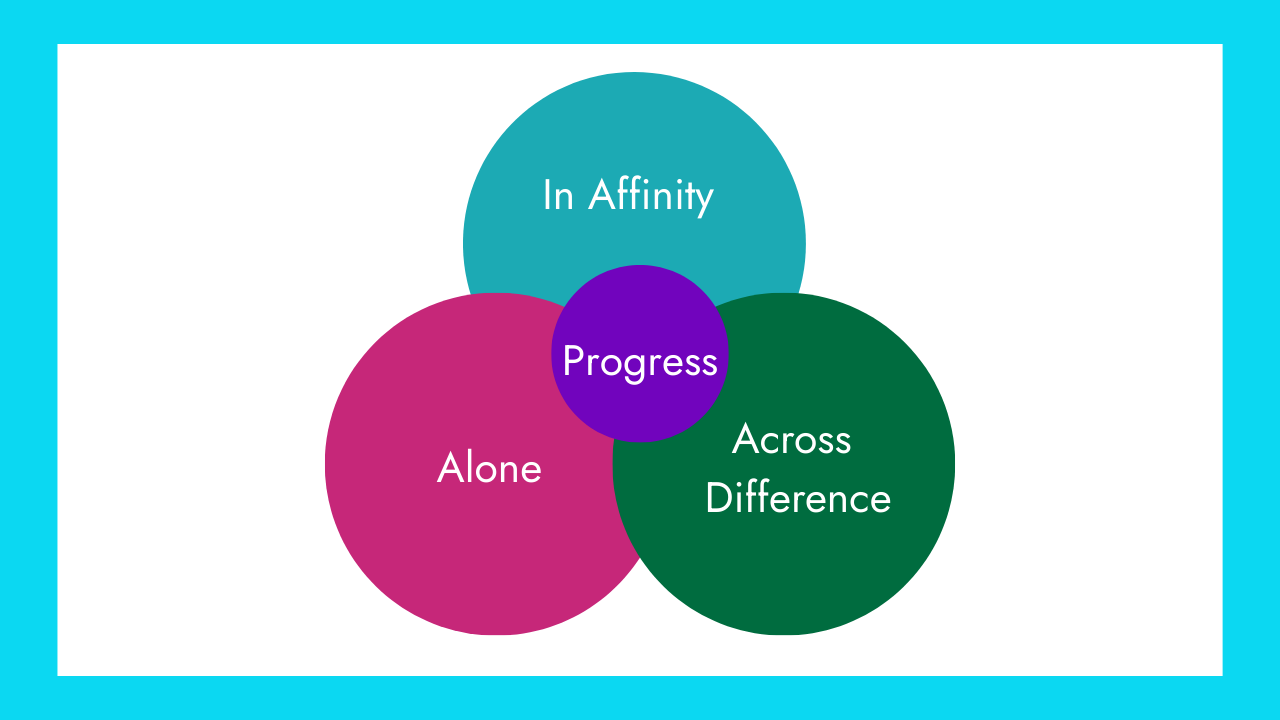
There are many things that have stayed with me from a career in social impact: relationships, fundraising strategies, and an understanding of what “social enterprise” actually means. But the learning I refer to most came from a mentor steeped in equity-centered practices, who distilled years of social movement work into one deceptively simple framework:
“We all have work to do: Alone. In Affinity. Across Differences.”
I lived this methodology first hand. I am an Ashkenazi Jew who walked the Silent March from Auschwitz-Birkenau to honor my people. I studied Arabic to understand a part of the Middle East I’d never been taught. I joined Progressive Jewish spaces and attended Breaking the Silence events on campus. And then I lived and walked across Jordan so I could understand history from a Palestinian perspective. All while traveling to my Israeli “friends-turned-family” home for Passover that same Spring.
I landed somewhere powerful: meaningful relationships, conversations, and moments with Palestinians, Israelis, passionate Americans, and seemingly indifferent folks until news hit the front page. Every time there’s a crisis in the Levant, I take calls from each category of person, each relationship built on the foundation of trust, mutual understanding, and honesty. I have never sacrificed my convictions for palatability; I have remained open to persuasion or new approaches to peace when presented with new information.
UNASB exists because its members refuse to stay in our bubble. We meet biweekly to dissect conservative-leaning podcasts, not to mock them, but to understand the messaging patterns that resonate with millions. We’re studying their techniques so we can have more effective, long-term conversations with people we disagree with.
Rather than defending UNASB’s approach, I’m inviting those who criticize our group to consider their own strategy. Whether people agree with us or not, the difficult truth is: what we’ve been doing for the last decade hasn’t worked, and isn’t working now.
How are you advancing the causes you care most about?
Though this framework was originally developed for equity-focused work in schools, specifically to support educator collaboration in multiracial contexts, I’ve repurposed it for democratic deliberation in an increasingly politically fractured nation.
Alone: We need to understand our individual identity and personal growth areas, but we can’t move the needle operating only from our personal convictions.
Affinity: We must explore our convictions in safe containers alongside those with shared or similar beliefs, but can’t change anything by staying in our echo chambers forever, surrounded only by people who already agree with us.
Across Difference: We have to build unlikely coalitions that lead to sustainable solutions. But we can’t move the needle by abandoning our convictions just to fit in with people who are different from us.
The framework of working Alone, in Affinity, and Across Differences isn’t about choosing one approach over another: it’s about committing to all three.
Because that’s what it takes to make lasting progress.
This framework isn’t theoretical for me; it’s the architecture underlying my time with UNASB and The Magnet Collective. The skills for healthy democracies, workplaces, and communities are the same: constructive conflict, productive conversations, and collaborative deliberation to create solutions better than the ones we have today. Not perfect -- Better. Progress. Whether in policy reform, workplace deliverables, or finally filling that pothole you’ve skirted around the last three years.
We can’t build better policies, systems, or structures without aligning the majority of people to a shared solution. Collaboration can’t happen without Good Conflict and communication. And productive conflict and communication can’t happen in just one lane. They must be practiced, reflected upon, and practiced again across all three: Alone, in Affinity, and Across Differences.
Alone
This is personal work: the unglamorous process of learning and unlearning. What will it take to interrupt hatred, bias, and fear, not just in society, but in yourself?
Without this work, activism becomes performative instead of transformative.
If you’ve made it this far, you’ve probably started this work already.
This is what allows me to listen to a two-hour Benny Johnson episode without rage-quitting or red-pilling. When I first started UNASB, I couldn’t make it through 20 minutes of content without calling a friend to rant or eating my feelings.
But the “Alone” work forced me to ask myself: Why does this messaging land with millions of people? Where am I dismissing valid concerns because of who’s expressing them?
This self-interrogation doesn’t mean abandoning my values; it means examining why I hold them and whether communication of my convictions actually resonates with the realities of most Americans. And exploring how my beliefs remain true to myself while expanding my suggested solutions to reach more Americans, not less.
In Affinity
This Circle is with others “like us.”
People who broadly share our identities, our commitments, or our lived experiences. Affinity spaces are a natural way for people to connect around something we have in common, whether that’s race, religion, political orientation, or simply a shared workplace.
UNASB is fundamentally an affinity space. We are left-leaning people who gather to study right-wing content together. A shared political starting point lets us do the hard work of genuinely understanding, not just criticizing, conservative messaging. We can say: “I kind of understood that argument,” or “That messaging technique actually makes sense” without being accused of betraying our values.
These spaces serve a critical function. They offer safety, affirmation, healing, and the ability to speak freely without constantly explaining or defending your lived reality. They’re where we can be vulnerable about our mistakes, ask questions we’re afraid to ask in mixed company, and hold each other accountable without the performance pressure of being watched by those we’re trying to reach and engage.
In UNASB meetings, we workshop how to respond to family members. We practice reframing progressive values using communication patterns that work in conservative spaces. We process frustration together so we don’t bring emotional reactivity into politically divergent conversations.
But affinity spaces become echo chambers if we never leave them. That’s why the framework requires movement between all three Circles. UNASB isn’t the end goal.
It’s preparation for Circle 3.
Across Differences
This is the hardest, and often most necessary, work: engaging with people who have different experiences, perspectives, and yes, different political beliefs. It requires curiosity instead of quick condemnation. Listening instead of rehearsing rebuttals. Maintaining our values while remaining open to understanding how others arrived at theirs.
This is why UNASB exists. Not so we can listen to conservative podcast strategy forever, but so we can have better, longer-term, more productive conversations with real people in our lives. So we can collectively build policies that better represent Americans’ pain points, some of which Democrats have clearly overlooked for decades.
This doesn’t mean debating bad-faith actors. It means building coalitions with people who feel differently but share common objectives. It means hard conversations with family instead of cutting them off. It means organizing in spaces where consensus is earned through deliberation, not granted because everyone in the room already agrees.
The goal isn’t to compromise our values. The goal is to build the kind of broad-based power that actually shifts systems. And systems don’t change because everyone agrees with each other. Things change because we build unlikely alliances, find common ground across differences, and create movements too large to ignore.
But you can’t do any of that without Circles 1 and 2. You can’t facilitate across difference if you haven’t examined your own triggers. You can’t persuade someone or learn from them if you haven’t practiced explaining your perspective with people who share your convictions first.
This isn’t about excusing harm or compromising on justice. It’s about recognizing that sustainable change has always required coalitions built on shared concerns, not forced rhetoric or same realities. These coalitions require compromise and strong, trusted relationships.
Movements don’t win by preaching solely to the choir. They win by expanding it.
In the past, I’ve ended friendships over social disagreements and yelled quip remarks rather than listen to another’s perspective. But these strategies: the call-outs, the purity tests, the assumption that if we just yell our values loud enough everyone will come around, they’re not working.
I’m so uninterested in being liked. Or even in being right. What I am most interested in now is winning for my people. For my friends with a different skin color than me. For my neighbors on food stamps. For my family of teachers, unsure if going to work means enduring “Know Your Rights” trainings, preparing for a school shooting, or actually teaching.
I don’t have all the answers. But as a dear friend & mentor recently reminded me, doing the same thing and expecting different results is the definition of insanity.
What might we gain by trying something new?
Progress has never come from a single approach.
So before dismissing UNASB as naive for studying conservative podcasts, I invite you to map your own strategy onto this framework.
Are you doing your internal, personal work?
Are you building accountability with people who share your commitments?
Are you engaging, really engaging, across lines of difference?
We do the work alone to ground ourselves.
We do the work in affinity to sustain ourselves.
And we do the work across differences to actually change the systems we’re currently stuck in.
If we abandon any one of those Circles, we fail.
The stakes are too high. Our communities are fracturing. Our workplaces are fleeing. Our democracy is fraying. And the only way forward I’ve found that actually works is the hardest one: doing the internal work, building confidence in affinity, and then meaningfully and productively engaging across differences.
In fact, I would argue that UNASB and strategies like it might be the most promising move we have in our repertoire.
If you’re on the fence, how would you change our strategy to make progress?
I’d like to deliberate.
 | A guest post by
|
Thought-provoking—thank you.
You motivated this Ashkenazi baby boomer to comment. I created my own Substack and continue to value the comments, conversation, and community it offers.
The Substack universe feels vast until I realize(d) it's actually a tight bubble. As a professional, I often used Venn diagrams as teaching and strategic tools. Your discussion got me thinking about how they help explain why Substacks are bubbles. They resemble a Venn diagram where the circles of readers, writers, and commenters heavily overlap—we're all reading each other's work, commenting on the same posts, and having recursive conversations. We create an echo chamber that feels like intellectual diversity but is actually insular.
I'm a member of many progressive groups that also resemble bubbles, whether democratic, political, or otherwise. I write a Substack. I contribute to the bubble. Your Venn diagram concept might help Substack and progressive thinkers develop solutions to my grouchy complaints.
Perhaps you could write a piece that would help me and others "think outside the box." Thanks again.